"The trouble with life is the stupid are cocksure and the intelligent full of doubt." --Bertrand Russell “Never be a spectator of unfairness or stupidity. The grave will supply plenty of time for silence.”--Christopher Hitchens
Sunday, April 21, 2013
Lindsey Graham and Tsarnaev: Almost Racist
A friend who worked for the U.S. government in an agency which oversaw international trade once remarked, with a Cheshire smile, "We worry a lot about whether or not we are racist in this country; we don't hold a candle to the Europeans."
He spent a lot of time in England, Switzerland, Germany and Scandinavia, so I thought he probably knew of what he spoke.
Today's New York Times carries a stunning article by Jonas Hassen Khemri, the first generation son of an immigrant to Sweden.
He details what is was like growing up dark skinned in Sweden: being stopped on the street, questioned, asked for government ID, thrown into the back of a police van, then told only , "You may go now." Listening to government ministers defending racial profiling blandly by saying, "Oh, well, they are the guilty ones." Watching his father sweating out interrogations by Swedish officials, who looked at his government ID dubiously--this guy says he's Swedish, well he doesn't look Swedish. Hearing of friends beaten up in police vans. Followed about in stores by security guards with walkie talkies, who assumed if you are dark skinned, theft must be afoot.
It all sounds like stuff we have put behind us in the United States, having faced our own different modes of racism forthrightly. Of course, until now we haven't succumbed to that special terror of government power--the National ID--which some of us remember from the old movies in which the Gestapo stops Lauren Bacall or some other heroine and says, "Unt now, I vould like to zee your papers." Red staters rage about the indignity of background checks for gun purchases, but they have no reservations about the indignity and huge leap in government control embodied in a national ID card. You want to see real terror and oppression: Just vote for a national ID card.
We've gotten by that sort of thing here in the USA. Well, mostly.
Of course, not all of us. When the Boston bombers turned out to have been born in Russia, and, damn it, one was dabbling in Islam, well, Lindsey Graham is right there with the "Suspend the Constitution!" cry. Hey, why should we give this ungrateful foreigner any rights? Let's just hang him now without a trial (a South Carolina specialty) or put him away for life.
Well, there's precedent for life imprisonment, no trial--Gitmo.
And also Stop and Frisk in New York City, the city of Michael Bloomberg a semi liberal mayor, who apparently is not disturbed by racial profiling, if it happens in zip codes where people don't have much money or power. Mayor Bloomberg worries about allowing people to drink gargantuan soda pop but he does not worry about people thrown up against a wall by his own police.
Mad Dog would like to humbly suggest: The reason we go through the dance of doing things within the Constitution is not out of respect for heinous criminals; it is for ourselves. We do not take the pains and expense of trials for the sake of the accused, any more than we do funerals for the sake of the dead. We do funerals for the sake of the living and we do trials for the sake of the citizens who do not stand accused, that we may all demonstrate our respect for a little mentioned and oft ignored idea: The Law.
We are better than the guys who set off bombs and blow legs off people because we think hard and long before we do harm to anyone.
Having cared for wounded accused in emergency rooms and on the wards, Mad Dog was struck by how surprised they were by the kindness, or at least by the absence of hostility they saw in the nurses and doctors rendering care. In some cases, Mad Dog had the impression these men had never experienced human kindness and it was disturbing to them. They were suspicious at first, then tentatively responsive, but often they withdrew again, as if they knew responding to kindness would make them vulnerable, so they retreated into indifference. Some of them could not help themselves, however and they were the ones most often psychologically damaged--by all the respect and fairness. So Mad Dog doesn't buy the approach of the Lindsey Grahams of the world. Just beat those miscreants like dogs. No, if you really want to make them suffer, treat them with respect and they begin to feel a connection to humanity. That's the greatest pain.
You want to really inflict pain on the surviving Boston bomber? Once you have him reasonably stable and comfortable, once you have shown him care and concern and made him feel well again, bring around one of those girls who knew him in high school, or from college, one of those girls who called him a "sweetheart" who thought of him as a kind, funny, caring person, and simply allow them to visit; allow him to return to that person he once was. As Mephistopheles says in Faustus, the greatest hell is remembering happier times. The greatest hell for this 19 year old will be remembering the person he was before he was transformed.
So, with our system of laws, of treating the accused as innocent until proven guilty, we honor not the accused, but ourselves. We worship at the alter of "justice."
Well, mostly--unless you are a villager blown up by a mistaken drone attack.
But, at least, most of the time, outside of Gitmo, and drone attacks and Stop and Frisk, we try.
Nobody's perfect.
One way to feel better about yourself today: Consider Lindsey Graham. Consider his whole ridiculous state. If you have done something lately you think was pretty stupid or ill considered, just think of Lindsey Graham. Compared to him, compared to the several million people who voted for him and live their smug little lives in South Carolina, you are a tower of intelligence, discretion and moral fortitude.
Friday, April 19, 2013
Dzhokhar Tsarnaev: A Wounded Animal
"I did know Jahar. In the 4 years of high school I spent with him, he was nothing but a kind, unassuming, gentle person. He was funny, had lots of friends, and was very athletic. I haven't spoken with him since high school (we graduated in the same class from Cambridge Rindge & Latin)."
Another acquaintance said she knew Dzhokhar from the University of Massachusetts-Dartmouth. She said he had a group of "maybe four or five" Russian-speaking friends whom he was never without. "All I really knew of them was that they smoked weed and liked to party, just like regular kids. Jahar was such a sweetheart."
--From the Internet
So how does a kid who enjoyed his friends, seemed engaged, had success in school wind up fashioning a bomb which blows the legs off people, robbing a 7 Eleven, shooting a policeman to death, throwing bombs at police?
Of course, Mad Dog wondered whether or not the police could have been wrong about the role these two brothers played in the bombing. Showing them walking down the street carrying backpacks hardly proves they had bombs in those back packs. But if they really did throw bombs at police, were caught on surveillance robbing a 7 Eleven, were identified by the man whose car they hijacked, sounds like a case which might get an indictment out of a grand jury.
Assuming for the moment the police got the right guys, Mad Dog asks: How do you go from being a kid who is embraced by his friends to a maniac who is alienated enough to kill wantonly?
They interviewed a man in Watertown who said he was happy the kid had been captured alive because he wants to hear him answer a lot of questions.
Mad Dog is not sure the answers will actually provide much insight. But if he were dead, there would be zero chance for answers.
It is hard to work up much sympathy for the person who blew legs off people, but the image of this 19 year old crawling off to die in the backyard boat of some Watertown citizen does strike even the cold black heart of Mad Dog as sad. A wounded animal is always pretty pathetic. Once they are defanged, no longer a threat and just dragging themselves off to find a hole, it is not the same.
Mad Dog knows the obvious question is coming: Would you have felt that way if there were footage of Hitler dragging a leg behind him, off to his bunker? And the answer is: No. Mad Dog would be unmoved.
But a 19 year old kid, who not long ago was a "sweetheart." Makes you wonder.
Thursday, April 18, 2013
Boston Bombing: The Banality of Evil
Hanah Arendt, commenting on Adolph Eichmann on trial in Israel, reflected on the banality of evil. The people who carried out Hitler's final solution, for the most part, were not foaming at the mouth fanatics, but ordinary people who simply bought into the Third Reich's notion that killing Jewish babies and Roma was a good thing.
Looking at the images of the two young men suspected of participating in the Boston bombing, a red headed woman on the street was shaken by their ordinariness: "They could be anyone," she said with a shudder. "They look so unremarkable."
Most people seemed to harbor a working hypothesis about their motivations. Mad Dog assumed they were avenging drone strikes in Afghanistan/Pakistan which have killed innocent villagers. Others have suggested it was some libertarian anti tax group. Each person seems to have a favorite villain, depending on that person's most cherished group to hate.
But what will we do with the information, if it ultimately does come out? If it turns out to be an Afghan out for revenge? Or if it is a latter day Columbine alienated teen ager group? Or if it is a white supremacist group? Mad Dog supposes we'll use the information to support our own biases: See, that's where that type of thinking leads to-- the killing of innocent people.
In the end, the result may be a surprise: Some years ago a sniper shot people in the Washington, DC area in what appeared to be a totally random way. Police were looking for a white guy in a white van. It turned out to be a black man and a black boy firing from the trunk of a dark sedan. The man was out to kill his ex wife, and the other shootings were a ruse. If he had shot only his wife, he would have been the prime suspect, but if he shot her as part of a random shooting spree, she's just another random victim.
Or, we may never know, just as we never knew who sent those Anthrax ladened letters. Now we have letters to President Obama laced with Ricin. An echo from the past.
Oddly, just days after Boston, a fertilizer plant leveled much of a Texas town. Timothy McVeigh used a fertilizer bomb to level the federal building in Oklahoma City. Echos from the past.
Has Rush Limbaugh had time to say, "Nobody's talking about background checks for people who buy fertilizer" yet?
We are fortunate to have someone in the Presidency who can rise to these occasions. After eight years of cringing, what a relief to hear from a man who can soar rhetorically, and who can rally our spirits.
Tuesday, April 16, 2013
Boston Bombing: When News is Bogus
The news from Boston was pretty bleak, made bleaker by the efforts of careerist reporters, who were thrown on television and radio with no news to report, but with hope in their hearts this could be their own big moment. So they interviewed each other and repeated the words de jour : "Chaos" and "Heart wrenching" and "Like a war zone" and "panic."
Which is to say, the news people had no news to report beyond the first three minutes: Two explosions ripped through crowds around the finish line of the Boston marathon after the first wave of (fastest) runners had finished, and at a time when the spectators lining the street had diminished in number. Had the bombs gone off earlier, casualties would have been higher. Police are in the early stages of painstaking investigation and really will have nothing to say until they gather evidence and reconstruct and think out what the evidence means, which means we will all just have to wait to learn what happened.
There was alarm and there was surprise, but there was not "chaos,"as far as Mad Dog could see: Doctors who were in attendance in significant numbers ran straight toward the victims lying across from them, despite the obvious danger, and police reacted with calm and deliberation and the hospitals swung into their well rehearsed "disaster" drills, as they have been trained to do, and patients were transported to the waiting teams at Mass General, Tufts and Boston Medical center and operating room teams awaited them and treated them, and intensive care units received them, even at Childrens' Hospital, and while many questions remain about who did this, why, and how, what was never in question was the proficiency, efficiency and efficacy of the medical community, one of the nation's best--in Boston--and the calm deliberate and speedy response of the "first responders" the police, fire and rescue.
As far as Mad Dog can bring to mind, this is the first attack which actually took a toll of civilians since 9/11/2001. There have been thwarted attempts--the shoe bomber, the underwear bomber and the Times Square bomber, but this is the first that went off and killed people since New York, 2001.
Speculation immediately was centered on Middle Eastern terrorists, as it was immediately after the Towers came down in 2001. In the case of the Towers, that speculation was basically on target. Not so clear here, yet.
It must be remembered, Timothy McVeigh fit nobody's profile of a Middle East terrorist.
As any fan of The Wire knows, there is much that can be learned from a patient, thorough, unhurried examination of the crime scene, done without bias or preconceived notions, just methodical, meticulous and clean. When emotions run high, sometimes the in charge cop has to order everyone out of the area, just to allow those with specific tasks to do their jobs.
Eventually, we will learn more of value, but watching the yammering nabobs on TV Monday, we saw the worst of the commercial news making machine. They did not serve the nation well.
Saturday, April 13, 2013
The Trouble with Public Schools: Trying to Imagine the Nazi Point of View
Mad Dog begs the reader's indulgence: Let it be understood, Mad Dog attended public schools until he matriculated at a private college. One of Mad Dog's sons went to public schools, the other to private schools from high school through college.
So Mad Dog claims experience in both realms, and no particular emotional attachment to either.
In today's New York Times is an article about a high school teacher in Albany, New York who assigned her class the task of writing a "persuasive piece" using traditional high school essay structure (5 paragraphs: introduction, 3 paragraphs, conclusion) as an argument to a Nazi teacher "Jews are the source of our problems." "You must argue Jews are evil and use solid rationale from government propaganda to convince me of your loyalty to the Third Reich!"
Now, of course, no analysis is on firm ground without knowing the facts, and we do not have all the facts in this newspaper report. Did the teacher give the students other options? Could they in fact choose some other topic designed to make them think in terms which most current Americans find repugnant? Did the teacher preface the assignment with a discussion of what the Nazis espoused, the history and outcomes of their time in power? What, in short, was the context of the assignment? Did students object? What was the response to their objections? And what did she mean by "solid rationale?" What does anyone mean by that?
All we know is Maruertie Vanden Wynagaard, the superintendent of Albany's schools said, "Obviously, we have a severe lack of judgment and a horrible level of insensitivity."
Obviously, we have Ms. Wynagaard concerned to protect her own job, but it is not at all obvious we have a lack of judgment.
Rabbi Eligberg said, "The assignment was flawed in its essence. It asks students to take the product for a propaganda machine and treat it as legitimate fodder for a rational argument. And that's just wrong."
Actually, not.
Clearly, the rabbi does not like the exercise of mind games. The rabbi wants only to hear, "This is wrong." He is made uncomfortable by or has never attempted, the exercise of inhabiting "evil," living in its skin, getting its feel, moving within it.
Mad Dog has on occasion tried to get into the mind of really freaky people: Republicans like Paul Ryan, various Texas and South Carolina senators and Congressmen, Rand Paul, Mitch McConnell, and even, yes, people like Joseph Goebbels and Adolph Hitler, and Henry Ford (author of "The International Jew.") It is a clinically useful exercise: Imagine I am a germ. What would I do? What would give me pleasure and what would I seek?
In law school, I am told, students are made to argue for the defense and then assume the role of the prosecutor. It's a way of making them identify the types of arguments made and to understand the vulnerabilities of these arguments. It is a way to prepare oneself for the fight.
But in public schools, students and teachers alike have to be always mindful of "how it would look" or "how that might sound" if some politically unpopular or incorrect statement leaks out from the classroom into the press or general public.

The superintendent, we are told, met with "Jewish leaders" in Albany to assure them she did not endorse the Third Reich, Adolph Hitler or anti Semitic sentiments.
All this sounds very familiar to Mad Dog. By the time he finished 12th grade, he was convinced his teachers, with some happy exceptions, were mediocrities and not smart enough to teach their much more intelligent students.
The whole dreary exercise of form over content--5 paragraphs. Why five? Introduction, conclusion. What is so important about that? What makes that form "good?"
In college, where the professors were not looking over their shoulders, the discussions were so much more intelligent and relevant and deeply cutting. There was no superintendent meeting with community leaders to reassure everyone children in classrooms were not being taught Nazi doctrine as received truth.
Mad Dog has often fantasized about what if? What if, in a former life, Mad Dog had been a Hitler Youth? An SS trooper? A concentration camp guard? What would that have felt like? How would he have dealt with the cruelty?
Mad Dog realized it might have begun with love, of all things. Listen to Hitler's speeches and notice how much time he spends building a picture of beauty, an imagined world of blond, blue eyed, healthy, smiling, happy boys and girls, those darlings of the Third Reich who will sweep away the badness and replace it with purity. All those efforts to breed beautiful blond girls with beautiful blond boys. And the movies of those Aryan youths--it's all so euphoric and Hitler riding by, standing in an open automobile, arm straight out and women thronging to him, arms outstretched in ecstatic salutes; they are weeping with joy.
You are taught to love, to desire, blond hair, white skin. That can look so clean. And after the mud and grime of WWI trenches, clean must have been a very sacred thing. Then you see people who dress in black and wear long curls for sideburns and who do not look like that blond ideal. Can you feel the repulsion? But what of their children? Do you not feel badly murdering the children? Well, but children grow up.
You get the idea: You can, by suspending your own conditioned responses, get to a new place and see the world, however tendentiously, from behind different lenses.
And you can use that knowledge: When Mad Dog was an intern, working on a ward where people were dying in droves every day, he and everyone he worked with, became inured to the significance of death and physical destruction. As nurses wrapped bodies, they chatted about which bar they were going to after work. And Mad Dog recognized: We are no longer even seeing these people we are packaging. He could see that because he had imagined that kind of behavior before.
And from that perspective, you can achieve a new power to attack the flaws in the thinking, the perceptions.
In his own life, Mad Dog was raised as a white child among people who were soul mates to the Nazis. White Southern racists, who earnestly told you swimming in the same swimming pool as Blacks would infect you, for whom the idea of a white girl dancing with a black boy at a school dance was nothing less than miscegenation, for whom homosexuality was a sin against God, for whom Catholics were suspect, Jews barely tolerated pariahs, and the best life on earth was for two white Christian people, boy and girl, to meet in high school, marry after college and produce three little pure white children who would repeat the cycle.
So anything which rattles a cage strikes Mad Dog as a step in the right direction. That cannot happen in schools which are publicly funded, politicized, where teachers must teach to the tests to satisfy the political postures of downtown politicians, schools run by careerists who care only for their own jobs and naught for something as lofty as opening young minds.
Wednesday, April 10, 2013
Hampton to Portsmouth: A Test of Character
For most of his life, Mad Dog lived in Washington, DC, and whenever he would meet someone from overseas he would ask, "So what is different about living in America?" It did not matter whether the ex-pat was from England or Italy, Germany or Spain, Norway or France, he or she always said the same thing: "You Americans: You drive everywhere!"
This was usually followed by a deep sigh and then a flabbergasted look: "If there is a 7-Eleven a half mile down the road, you will drive down there, for a loaf of bread and a quart of milk!"
New Hampshire, for the most part, is not pedestrian friendly. You can walk on sidewalks in Hampton or Dover or Portsmouth, but outside of the commercial centers, any citizen fool hardy enough to walk or bicycle much beyond town center takes his life into his own hands.
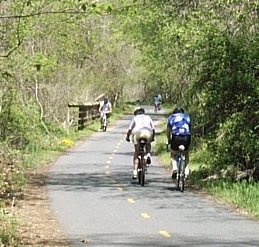
Mad Dog has now walked or skied nearly the entire length of the abandoned railroad bed from Hampton to Portsmouth and he is convinced it would be wonderful space for a paved bicycle, walking, roller blading path.
But it is a big project. Pulling up all that track and hauling it away, preparing a surface for paving, laying down the asphalt, whew! There are about half a dozen homes within sight of the path. Those owners may object. There are about half a dozen industrial properties along the way, mostly in Hampton and Portsmouth; again, there may be resistance from the owners.
Mad Dog has learned from the many people who saw two letters in the Portsmouth Herald supporting the idea of a bicycle path free of cars, there have been prior efforts to convert the rails to a trail. None have succeeded.
This is one of those things which define a community, its leaders and its character. A bicycle path would not be used by the vast majority of its citizens. It would be available to all, but used by less than 10%, at least at first.
But it would, like the ocean, become part of what draws people to the Seacoast and what makes it vibrant.
How do you put a dollar value on what it would mean to have a 10 mile refuge from the automobile for families, for exercise addicts, bicyclers, roller bladders, walkers, runners, bird watchers?
You may note the Mad Dog omits "hunters." One hopes hunters would be excluded from this swath. Not that Mad Dog has anything against hunters--but he does not like hunters shooting off guns along a path where children ride bicycles.
You have to say that in New Hampshire. Hunters by law may hunt on the Sagmore Creek 100 yards from Route One and along the Urban Forest trails where mothers and children walk their dogs. Somehow hunters' rights take precedence over family rights in New Hampshire. But Mad Dog digresses.
The fact is, this effort is going to be made again. We are told the likelihood is there will be meetings, petitions, hearings and ultimately, no action. It is usually easier to do nothing than to create something. We'll see what New Hampshire is made of in the upcoming weeks and months.
Sunday, April 7, 2013
Guns: Class Warfare and the American Divide
Dan Baum in conversation with Joe Nocera in today's New York Times makes some good points about efforts to diminish gun deaths.
Before Mad Dog gets to that, a disclaimer of sorts: although Mad Dog has never owned a gun, he has gun owners in the family. And Mad Dog does have one bit of relevant personal experience. When Mad Dog was a medical intern at a big city hospital the head nurse on one of the wards he covered at night locked up all the needles and syringes. Nurses would call Mad Dog to see a patient on that ward who needed a blood culture drawn, but there were no needles available. Mad Dog would have to hunt down the ward nurse in the dark and he finally gave up and just ran down a flight of stairs for the unlocked supplies on the ward below and ran back up fully loaded to do his blood culture. When Mad Dog complained to the head nurse she said she locked the needles to prevent drug addicts from getting them. "But the drug addict would have to walk up nine flights of stairs, past all those other wards with open needle cabinets to steal your needles!" The head nurse was unmoved. "It's the law," she said. "And if other head nurses want to leave their needles vulnerable to theft, that's their business."
So Mad Dog has some experience with ineffective efforts at prevention. And he has felt the anger of the self righteous.
Now needles used by drug addicts are different than guns used by maniacs. As my resident said at the time, "I hope drug addicts are stealing clean needles. At least they won't be re using old ones and spreading hepatitis." Guns are never used for purposes of administering healthful doses of anything.
On the other hand, Dan Baum makes some good points: For one thing, if you look at statistics, assault rifles are used only in the most spectacular but rarest events. We do not worry as much about hand guns, which kill far more Americans every day. The thing is, when assault rifles have killed people, it was white, middle to upper class people and hand guns are the ghetto weapon of choice, killing mostly people in the zip codes that don't matter--who cares about deaths in the ghetto? When Nocera says parents ought to ask whether there is a loaded gun in the house before sending their kids for a play date, Baum says, fine but if you are really playing the odds, ask if there is a swimming pool--far more kids drown in swimming pools every year, but that's not as emotionally charged for the rest of us, and swimming pools are owned by rich people; guns are the narcotic of the Joe Sixpack class.
Baum's main point is there are at least 300 million guns out there right now; trying to limit sales is closing the barn door after the horse has left. As for limiting clip size, he is not as persuasive, but the answer usually is, the average maniac will accumulated lots of clips in his planning for the next shopping mall spree.
In Dodge City, Matt Dillon could disarm any varmint who rode into town and keep his gun at the jail until he left town. You cannot do that in America anymore. The varmints all have stashes of guns all over the place. So the argument from the gun owners is, these laws are ineffective. They are annoying in the same way the theatrics at the airport security gate are annoying--anyone can see through them to a way they could defeat the system. The net catches the wrong fish.
Baum's main argument is the intention of guns laws is to make us safer and limiting assault rifle sales does not do that. He is saying these are feel good gestures to allow politicians to posture and say, "See, we've responded!" In fact the response is half baked and transparently ineffective, affecting the people who are not the problem and leaving the bad actors unaffected.
His secondary point is the people who love their guns feel insulted and vilified. And he has a point. A subtext to this argument is rich, urban, upper class people who do not own guns look at rural, less affluent people who cling to their guns as pathetic, relatively powerless people who can only get a sense of self importance by brandishing a gun, by going to a shooting range and making noises and feeling the power of the machine in their hands. When President Obama gave a speech in Portsmouth, some fool showed up carrying a big gun in the parking lot outside the high school and made all the papers. What he was saying is, "Look here. I have a gun. That means I could kill President Obama, which means I am as powerful and important as he is."
But not all gun guys are that pathetic. People love guns for, likely, deep psychological reasons--a sense of power, a sense of potency, a sense of self reliance, a sense of I may make only a small fraction of what you make, but I'm a lean, mean killing machine. Some actually simply like the workmanship of guns, and they look at them as works of art. They collect them but do not fire them. Or they like skeet shooting.
It does stick with Mad Dog that in the Army, when recruits are sent out to the shooting range they are given a certain number of bullets and they had damn well better return with that exact number of spent casings. Every casing is counted and every bullet accounted for. The Army does not want any recruit using a bullet on his drill instructor. In the real world, the government cannot keep that kind of clamp on its citizens. When the government tries to clamp down on objects, whether they are books or guns or vials of drugs, it always entails invasion, search, seizure.
Some years ago, Mad Dog was walking down a New York City street, carrying a long umbrella and a police patrol car screeched to a halt and a policeman jumped out of his car and demanded the umbrella. He twisted and pulled at it to no effect and finally handed it back to the dumbfounded Mad Dog. "Looking for a sword inside," the cop explained, a little sheepishly. "I feel safer now," Mad Dog said, being careful to smile. Of course, Mad Dog was trying to make the policeman feel better. His heart was in the right place. But if Mad Dog had been walking in Bedford Styvestant last week and a policeman had thrown him up against a wall and frisked him as part of Stop and Search, Mad Dog would have been outraged. If Mad Dog had been hauled off to the station house and strip searched, he would have been on the phone to his Congressman and if Mad Dog had been thrown into Gitmo, he would have spent every day planning his revenge against a government which could be so evil.
Somehow, the argument has to progress beyond the emotional and the personal to a level which the article by Mr. Nocera and Mr. Baum approached today.
Before Mad Dog gets to that, a disclaimer of sorts: although Mad Dog has never owned a gun, he has gun owners in the family. And Mad Dog does have one bit of relevant personal experience. When Mad Dog was a medical intern at a big city hospital the head nurse on one of the wards he covered at night locked up all the needles and syringes. Nurses would call Mad Dog to see a patient on that ward who needed a blood culture drawn, but there were no needles available. Mad Dog would have to hunt down the ward nurse in the dark and he finally gave up and just ran down a flight of stairs for the unlocked supplies on the ward below and ran back up fully loaded to do his blood culture. When Mad Dog complained to the head nurse she said she locked the needles to prevent drug addicts from getting them. "But the drug addict would have to walk up nine flights of stairs, past all those other wards with open needle cabinets to steal your needles!" The head nurse was unmoved. "It's the law," she said. "And if other head nurses want to leave their needles vulnerable to theft, that's their business."
So Mad Dog has some experience with ineffective efforts at prevention. And he has felt the anger of the self righteous.
Now needles used by drug addicts are different than guns used by maniacs. As my resident said at the time, "I hope drug addicts are stealing clean needles. At least they won't be re using old ones and spreading hepatitis." Guns are never used for purposes of administering healthful doses of anything.
On the other hand, Dan Baum makes some good points: For one thing, if you look at statistics, assault rifles are used only in the most spectacular but rarest events. We do not worry as much about hand guns, which kill far more Americans every day. The thing is, when assault rifles have killed people, it was white, middle to upper class people and hand guns are the ghetto weapon of choice, killing mostly people in the zip codes that don't matter--who cares about deaths in the ghetto? When Nocera says parents ought to ask whether there is a loaded gun in the house before sending their kids for a play date, Baum says, fine but if you are really playing the odds, ask if there is a swimming pool--far more kids drown in swimming pools every year, but that's not as emotionally charged for the rest of us, and swimming pools are owned by rich people; guns are the narcotic of the Joe Sixpack class.
Baum's main point is there are at least 300 million guns out there right now; trying to limit sales is closing the barn door after the horse has left. As for limiting clip size, he is not as persuasive, but the answer usually is, the average maniac will accumulated lots of clips in his planning for the next shopping mall spree.
In Dodge City, Matt Dillon could disarm any varmint who rode into town and keep his gun at the jail until he left town. You cannot do that in America anymore. The varmints all have stashes of guns all over the place. So the argument from the gun owners is, these laws are ineffective. They are annoying in the same way the theatrics at the airport security gate are annoying--anyone can see through them to a way they could defeat the system. The net catches the wrong fish.
Baum's main argument is the intention of guns laws is to make us safer and limiting assault rifle sales does not do that. He is saying these are feel good gestures to allow politicians to posture and say, "See, we've responded!" In fact the response is half baked and transparently ineffective, affecting the people who are not the problem and leaving the bad actors unaffected.
His secondary point is the people who love their guns feel insulted and vilified. And he has a point. A subtext to this argument is rich, urban, upper class people who do not own guns look at rural, less affluent people who cling to their guns as pathetic, relatively powerless people who can only get a sense of self importance by brandishing a gun, by going to a shooting range and making noises and feeling the power of the machine in their hands. When President Obama gave a speech in Portsmouth, some fool showed up carrying a big gun in the parking lot outside the high school and made all the papers. What he was saying is, "Look here. I have a gun. That means I could kill President Obama, which means I am as powerful and important as he is."
But not all gun guys are that pathetic. People love guns for, likely, deep psychological reasons--a sense of power, a sense of potency, a sense of self reliance, a sense of I may make only a small fraction of what you make, but I'm a lean, mean killing machine. Some actually simply like the workmanship of guns, and they look at them as works of art. They collect them but do not fire them. Or they like skeet shooting.
It does stick with Mad Dog that in the Army, when recruits are sent out to the shooting range they are given a certain number of bullets and they had damn well better return with that exact number of spent casings. Every casing is counted and every bullet accounted for. The Army does not want any recruit using a bullet on his drill instructor. In the real world, the government cannot keep that kind of clamp on its citizens. When the government tries to clamp down on objects, whether they are books or guns or vials of drugs, it always entails invasion, search, seizure.
Some years ago, Mad Dog was walking down a New York City street, carrying a long umbrella and a police patrol car screeched to a halt and a policeman jumped out of his car and demanded the umbrella. He twisted and pulled at it to no effect and finally handed it back to the dumbfounded Mad Dog. "Looking for a sword inside," the cop explained, a little sheepishly. "I feel safer now," Mad Dog said, being careful to smile. Of course, Mad Dog was trying to make the policeman feel better. His heart was in the right place. But if Mad Dog had been walking in Bedford Styvestant last week and a policeman had thrown him up against a wall and frisked him as part of Stop and Search, Mad Dog would have been outraged. If Mad Dog had been hauled off to the station house and strip searched, he would have been on the phone to his Congressman and if Mad Dog had been thrown into Gitmo, he would have spent every day planning his revenge against a government which could be so evil.
Somehow, the argument has to progress beyond the emotional and the personal to a level which the article by Mr. Nocera and Mr. Baum approached today.
Saturday, April 6, 2013
Lunatics with Guns; Experts with Hubris; The Silence of the Lambs
![]() |
| Lunatic Giteau |
![]() |
| Experts |
![]() |
| President for 6 Months |
In 1881, President James A. Garfield arrived at the railroad station in Washington, D.C., accompanied by a friend, but no retinue of Secret Service Agents clearing a path. Presidents of the United States walked about Washington like normal mortals then. Garfield was in high spirits, on his way to his Williams College reunion. He had been a general in the Union Army, and now he was only a few months into his first term as President.
Charles Giteau, who wanted to be Ambassador to France, or possibly thought he was King of France, raised a pistol and fired several shots into the President from a few feet behind him, hitting him in the arm and sending one through his back into or near his pancreas.
Giteau was tackled and quickly removed to jail, where he expected General W.T. Sherman would send a company of troops to protect him and to thank him for his great deed. Garfield was carried to the White House where a team of surgeons, headed by an imperious and famous physician of the day, proceeded to kill him, by stages, by the probing of his wounds with bacteria ladened fingers and instruments.
Although the idea of antisepsis was well known in America in those days--Lister had presented their ideas to American doctors--the prevailing thinking in American medicine was that pus was a good thing and surgical instruments dropped on the floor were simply picked up and used, and not cleaned between cases.
In her lovely account of this dreary sequence of events, Candice Millard details the folly of the imperious doctor who ensured Garfield's fate, turning what could have been a serious but non lethal wound into a fatal blow.
There are lessons in history. We remember things in ways which are useful to us today. Of course, the obvious parallel between a maniac with a gun and the shootings at Newtown and Aurora is obvious. We have never been able to protect the innocent from the deranged very well, mainly because the nature of derangement is unpredictability. The lethally inclined maniac always has the element of surprise and often has planned to evade defenses.
For the denouement, the long road to sepsis for President Garfield, there are more lessons. The respect accorded experts was misplaced, should have been questioned and the authoritarian physician, had he been questioned more ruthlessly could have been prevented from doing more harm.
Alexander Graham Bell tried to quickly fabricate a metal detector to allow the localization of the bullet--there were no X rays then. But the doctors actually thwarted his efforts by refusing to move the President from his metal bed and Bell's metal detector could not distinguish one metal from another.
That Bell was famous was the only reason he was allowed in the President's room.
Fame, exposure, in America, has always been a substitute for real quality. Dr. Oz is listened to and believed because he is on T.V. David Stockman can get on the front page of the Sunday Review in the New York Times because he was famous once, even though his thoughts are manifestly stupid. Paul Krugman, a few days later, demolished Stockman's recycled version of Andrew Mellon and Herbert Hoover with only faintly dimmed contempt, as well he should have.
In American resumes, "Appeared on Ophra" or "As seen on TV" is proudly displayed as a badge of authority. I have been heard by millions: I must be smart.
Shakespeare said, "Speech is logic," which meant, if you say something, especially if you dress it up with elocution and a good suit, people will believe it; it is persuasive if only because you have said it.
The great failing of American education is not enough children are taught to doubt, to question to separate what is being said from the aura of the person who says it. When a local politician says that building a motorway, two lanes from Hampton to Portsmouth, will reduce idling time on Route One and thereby reduce air pollution better than creating a bicycle path in that same space, and the Portsmouth Herald publishes that without comment, speech is logic. Discourse on the seacoast is brought down to the lowest common denominator, to below that.
Our local papers, and even some national papers routinely fail to ask the obvious follow up question, to challenge authority, to seek a rebuttal.
David Brooks writes today that American universities should teach people how to disagree pleasantly. Mad Dog disagrees. Where people disagree politely, in the South, things do not change. The most outrageous things can be said and people say, "Well, I understand where you are coming from and you make some good points, although I cannot agree with your conclusion," when what they should said is: That is a mean, nasty and misguided sentiment and is not worthy of discussion and you should think twice before you say such things in public. To say Blacks should not be allowed to swim in swimming pools with Whites is not an opinion to be entertained over tea and biscuits with pleasant smiles.
Stringer Bell, who is running a meeting according to Robert's Rules of Order, explodes and cuts off an impertinent questioner with the explosion, "This nigga's too ignorant to have the floor. I will punk your ass, say such things!"
A little more Stringer Bell and a lot less David Brooks would do New Hampshire a great service now and then.
Wednesday, April 3, 2013
Leaders
![]() |
| Best& Banting |
![]() |
| Edison |
![]() |
| Yersin |
![]() |
| Sherman |
Some days, walking from the library to a late afternoon class, he realized he had not spoken to another human being for days. He looked forward to class because he would have contact with other people, but he did not need that interaction the way so many of his classmates did. He could study alone, be alone, and he noticed his dorm mates could not tolerate isolation; they studied together, just to be in the same room; they walked to the cafeteria together; they had parties together and went out on double dates. They seemed afraid to be alone with themselves.
As Mad Dog progressed through training in later years, he found he could be alone on a ward and function without calling for help. He could apply himself to a problem and rely on his own internal resources to solve it. He found himself, in a way, in a position of leadership because of this capacity--nurses looked to him, waiting for orders. And he felt comfortable giving those orders, not because he was superior, but because he had been prepared by others and then he was capable of sailing the ship without the help of others.
In the world of medicine, real leaders are self directed, "inner directed" some academics call it. Frederick Banting, the Canadian surgeon who pushed ahead, alone, convinced the pancreas contained some critical element, the thing which turned out to be insulin, was such a leader. Alexander Yersin, pushed ahead to identify the causative bacillus of the black plaque, after being spurned by governmental authorities (Brits who had invested their hopes in a famous Japanese microbiologist, who botched the job). Thomas Edison worked for long stretches alone. Like Banting, he had capable and dedicated colleagues, but the cardinal feature of Banting, Yersin and Edison is they pushed ahead alone, undeterred by the opinions of others.
In American politics, the loner is not likely to be chosen as a leader. Lincoln, who some have called the loneliest of men, achieved his greatness by working with other men, by manipulating them, by persuading them but not by isolating himself, except at the times he needed to think through a problem; then he would isolate himself.
Mad Dog wonders whether some of the intractable problems we face in government today arise because we have elected the wrong sort of men to lead us; we have failed to appreciate the importance in leaders of the capacity to be self directed. We have men like John Boehner and Mitch McConnell who raise their sails to catch the wind, whichever way it is blowing, rather than setting their own course, and steaming toward the star of their own choosing. They are men of compromise and complexity, but they are afraid to be alone with their own thoughts and decisions. Mad Dog wonders whether or not it is this character flaw in our leaders which has hurt us as a nation.
Jimmy Carter is always held up as an example of the man who failed because he failed to involved other people; he was too much of a loner. But he had more flaws than that and but for a sandstorm in a desert, he might have been remembered far differently.
Apart from Mr. Obama, Mad Dog despairs of our leadership. There are some good men and women, smart people in Congress--Dick Durban, Chris van Hollen, Diane Feinstein--but they are swamped by the other variety. One has to fear for our fate, in the hands of the lemmings who lead us now. Start with the Republican majority in the House, add the Republicans in the Senate, not the least among them Kelly Ayotte, and look around and it's pretty bleak.
![]() |
| Lincoln |
Tuesday, April 2, 2013
Representative Democracy in New Hampshire
![]() |
| Heavy traffic? Build a bigger road! |
![]() |
| Not New Hampshire. Yet. |
![]() |
| Crescent Trail, Washington, DC. Notice what is not here. |
Something about obtuseness is just mesmerizing. You keep thinking: If only I could explain this concept adequately to this person, he could see the light. I just need to find the right words, the right images.
But, in fact, that's not the way it is. The willfully blind cannot see because they do not want to see.
If you know about roads for automobiles and you like these things, then you do not like alternatives to these things.
Now, consider converting an old railroad bed to a paved bicycle path, which will run through several towns, all the way from Hampton to Portsmouth. What will your mind conjure up?
Let's take a fling: How can we make this into something we already know? A road! A motor way, an autobahn. Roads are good! Build a road and commerce will flourish. Build a road and you will reduce crowding on the road which runs parallel to it, because, you know, there are only a finite number of cars, and so this number will now be distributed over a larger asphalt surface and the concentration of cars will fall. It doesn't matter that study after study shows trying to relieve traffic congestion by building more roads is only a way to create more traffic congestion, on the new roads. If you build it, they will come. More cars arrive to fill whatever asphalt surface you provide.
If you have never seen a successful rails to trails, all you can think of when you think of a bicycle path is a yellow line painted on the margin of a highway.
Such is the frustration of thinking people like Chris Muns, who want to try something which would be new for New Hampshire, although it has been done successfully in many other states across the nation: A paved bicycle path in a heavily populated, highly developed part of the state.
There is an unpaved bicycle path from Newmarket to Manchester, but this is far from any significant locus of development and population. What Muns is talking about would run right through the heart of Hampton, North Hampton, Rye and on into Portsmouth and it might transform life in these towns by providing an area where people might actually--imagine this--Walk!
Walk without cars whizzing within ten inches of you. Hampton has a few sidewalks, but for the most part these towns have little or no provision for foot travel. Walking a dog along the road, crossing a street, these are not what life in the Seacoast is built for. In these parts, you need a car to fetch a quart of milk. Even the sidewalk along Route 27 into Hampton offers no respite--you can walk along it, but you can barely speak with a companion, the roar of cars and motorcycles is so deafening.
The predicament of the New Hampshire pedestrian is like that of the kitten living in a house where they don't much like cats.
But we could change all that, if only we can get people like Fred Rice could to throw open a window to their minds and see the possibilities of a corridor safe from motorized vehicles, protected from the smell of gasoline and the roar of the engines.
But that brings us back to the problem: How do you get a man to see, who likes living in the darkness?
Sunday, March 31, 2013
Fred Rice: Hampton Nightmare
Today's Portsmouth Herald ran a story about the purchase of land carrying the abandoned rail road track between Hampton and Portsmouth.
Mad Dog has previously blogged about the potential for this track to be converted, in a Rails to Trails fashion, into a bicycle path open to hikers, bicyclists, joggers, roller bladers, children and their parents, all free of the dangers of automobiles. This is a dream which has been turned into reality all around the country.
Interviewed for this story was Fred Rice, a Republican Representative from Hampton, to the New Hampshire House of Delegates, who was quoted as saying this pathway ought to be converted into another roadway for cars. His rationale was: 1. If this were turned into a road, commercial development would inevitably occur along its path. 2. Building a 2 lane road to Portsmouth would reduce traffic along route one, reduce idling engine time and thus improve air quality.
Mad Dog kids you not: Mr. Rice actually allowed himself to be quoted saying these things.
As if adding a 2 lane road would reduce the volume of traffic on Route 1, which is actually not all that dense to begin with but certainly, at the times traffic is heavier, would be unlikely to be much relieved by a road with only an entrance at Hampton and an exit at Portsmouth. As if reducing idling time on Route1 would have any measurable effect on air pollution in the Seacoast. As if air pollution on the New Hampshire Seacoast is a problem at all.
Of course, politicians and city planner stopped claiming that building more roads reduces traffic congestion sometime in the mid 1980's after experience and studies demonstrated that building more roads simply adds more roads which then become filled and congested.
As for building a road to encourage more commerce, this will certainly come as encouraging news to all those merchants along Route One, who are struggling to keep their doors open even as we speak. If you build it, they will come. Except along Route One between Hampton and Portsmouth. Oh, well, if you build another, maybe the word will get out.
To argue that adding a roadway on which to burn more fossil fuel, as opposed to a bicycle path, which encourages people to abandon vehicles which burn fossil fuel, is something most people would have trouble saying with a straight face, even most Republicans, but then again, most people are not Fred Rice.
Mad Dog seems to remember, correct the record if Mad Dog is wrong, an exchange at a meeting some years ago when Mr. Rice argued for reducing taxes on cigarettes. His argument ran something like this: Reduce the cigarette tax and you will reduce the cost of a pack of cigarettes and consumers will buy more cigarettes and although you make less per pack, you sell more packs, so overall, you increase revenues.
Mad Dog rose unsteadily to his feet at this meeting, unsure of whether or not he had heard Mr. Rice correctly, or was being set up for some bizarre combination punch, and Mad Dog said, "Excuse me, but I thought the idea of a cigarette tax was only secondarily to produce revenue, but primarily to raise the price of cigarettes to encourage people to smoke less, not more. Cigarette smoking is, after all, I thought, something we wish to discourage."
"Well, " Mr. Rice replied. "Cigarettes are legal."
Which left Mad Dog rather speechless. So, as long as it's legal, we, as a state government should encourage increases in the volume of cigarette consumption. In fact, Mr. Rice had another argument: We would lure Massachusetts citizens across the state line to buy their cigarettes in New Hampshire.
"So, you want to export our cancer to Massachusetts?" Mad Dog asked.
This was lost on Mr. Rice.
This scene was so surreal, Mad Dog has, ever since, questioned whether or not it actually happened. But reading Mr. Rice's comments today in the Herald, Mad Dog is inclined to believe it actually did occur.
Mr. Rice, a duly elected Representative from Hampton, New Hampshire, is quoted as saying the best way to reduce air pollution along the seacoast is to build another road for gas fueled vehicles to use.
Really, you cannot make this stuff up.
Mad Dog thinks this is a Sasha Baron Cohen stunt. There is no Fred Rice. This is Sasha Cohen disguised as a New Hampshire House of Representatives Republican.
But then again, in the same House, a Representative testified that birth control pills cause prostate cancer and that abortions cause breast cancer.
She did not aver abortions cause breast cancer because some woman in the parking lot told her, but because multiple pregnancies are associated with a lower rate of breast cancer and, ipso facto, that means if you avoid multiple pregnancies, you will acquire breast cancer.
She and Mr. Rice must be drinking from the same bottle.
Saturday, March 30, 2013
Spring Comes to New Hampshire
It is 55 degrees Fahrenheit along the Seacoast today, between Hampton and Portsmouth. Dogs are chasing balls in to the surf. Snow on the south side of the street has melted away from the lawns, and snow on the north side is getting thinner. It feels very warm to people who have got through another New Hampshire winter. People are out in T shirts and shorts. Sprouts are pushing up through garden peat moss and dogs are nose to the ground, as the heat from the soil brings up smells to the surface.
We may yet get another snowfall, but even the old New Hampshire natives say we have turned the corner. We all feel as though we have made it past exam week and those of us walking around upright have passed some pretty tough courses. We feel we have earned this Spring.
It's not that people in the South do not welcome Spring, but they do not have the same sense of accomplishment we feel up here, just for making it through another winter. Those of us of a certain age know we may not have many more winters or spring times to enjoy. Each new turn of season somehow seems more precious now.
Dry roots stirring in spring rain, as Eliot said.
We look at the children and teen agers kicking up their heels, new colts testing their muscles and sinews, and we are envious. Testosterone is rising with the sap. Renewal and new life is coming to a white and gray country, and green up here is twice as bright and savored twice as much for the contrast.
There are lovely places all over the country this time of year. True, it's not all joy--manatees are dying in Fort Meyers with a red tide. But Washington, DC has azaleas budding and cherry blossoms coming. North Carolina has grass and magnolias. But up here in the frozen north land we have Spring stretching its arms after a long winter sleep and there's no place Mad Dog would rather be.
Subscribe to:
Posts (Atom)