Thursday, September 27, 2012

Megan McArdle: Animal Farm For the True Believer


 "A greater gap of incomes between successful and unsuccessful entrepreneurs (thus greater inequality) increases entrepreneurial effort and hence a country’s contribution to the world technology frontier. We show that, under plausible assumptions, the world equilibrium is asymmetric: some countries will opt for a type of “cutthroat” capitalism that generates greater inequality and more innovation and will become the technology leaders, while others will free-ride on the cutthroat incentives of the leaders and choose a more cuddly form of capitalism."

Paper cited by Megan McArdle in The Daily Beast by Acemoglu, Robinson, Verdies (Italics mine)

Here you have, in pretty undiluted form, the underlying assumptions, I would say "myth" of an economic theory which forms the core of true belief of Mitt Romney, Paul Ryan, Rush Limbaugh and the entire cast of one percenters.

Boiled down, centrifuged to a nubbin at the bottom of the tube, it says that without the incentive of huge economic benefit, innovations in science, engineering, physics, all the things which drive economies, which allow nations to progress from the stone age to the iron age to industrial revolution to the information age, cannot happen.  Innovation only happens when the risk takers, the heart breakers, the entrepreneurs are motivated by the prospect of huge cash rewards are allowed to succeed and to bury all those 99% left behind them.

This is the corollary to Animal Farm: Without individual motivation, you get freeloaders  who do no work, (the pigs, the welfare queens, the 47% of Mitt Romney)-- those depend on the work of others to support them. And you have the foolish work horses like Boxer, who ultimately use themselves up and get carted off to the glue factory.

In fact, when you look at innovations which have changed economies, and the lives of the great mass of people, they came from men who were working not for fortunes, but for glory, for the intellectual thrill of solving a problem, for the thrill of being able to present their crowning achievements to their colleagues, who had tried and failed to solve the same problems, who know what they are applauding.

Consider:  1. The development of insulin by three salaried doctors at the University of Toronto in 1921. No fortunes for them. Eventually, fortunes for Eli Lilly, to whom they turned over their work, for only modest financial reward.  2. The development of vaccines for polio, the Plague, influenza, which have saved more lives than any single innovation by pharmaceutical companies in search of the almighty dollar. All developed with either government money by academics on government grants, or by individuals who gained no financial reward, just satisfaction (Alexandre Yersin, plague vaccine.) 3. Radar:  developed by British government scientists.  4. The CT scan: developed by British salaried government scientists working in academia and a National Health System.  5. The Internet: developed by government scientists   6. Rocket and satellite science: more salaried government workers, first German, then Soviet and finally American.  Entrepreneurs?  Johnny come lately to all this because the bottom line was not evident until after the governments put those satellites up there in space.  

So societies where wealth is very unevenly divided are not the drivers of innovation and progress from which welfare states feed.   The innovation which really mattered most emanating from these societies did not come from the profit chasers but from the salaried, usually government or academic (sponsored by government) scientists and engineers.

The wonder is a society like America, where private industry is celebrated, can manage to carve out enough public dollars to do the things through their salaried, much reviled government workers, which allow the rapacious entrepreneurs to feed.  So our humble public servants build the roads, the bridges and develop the frontiers in space, satellite technology, medicine and basic science which the private guys use to get rich. 

Where would Henry Ford have been without roads?  Where would GM have been without Obama?   Where are all those farmers and manufacturers now with a bridge between Ohio and Kentucky which is clogged and deteriorating and backing up the flow of Midwestern goods down south, because John Boehner and Mitch McConnell are in a snit and don't care if the Midwest suffers as long as the sufferers get mad enough to vote Mr. Obama out of office?

You can hate government. You can slam the door to "your" room and stomp around and curse your parents for not letting you take "the" car (their car) so you can go out and party. But you are still a brat. 

Tuesday, September 25, 2012

Romney Care: Let Them Eat Cake


Hello Mr. and Mrs. America and all the ships at sea. This just in from the New York Times, and possibly, 60 Minutes. The Republican candidate for President has reportedly answered the question:  "How do you propose to provide healthcare for the 50 million uninsured Americans."

Mr. Romney's reply:  "They already have an option: Emergency Rooms."

Does this man not have a doctor he can talk to?

Any doctor, anyone who reads a newspaper or listens to anything but Rush Limbaugh on the radio knows Emergency Rooms are the cake of the American health care system--if the doctor's office is the daily bread.

ER doctors (the real ones, not the ones of the re runs of the TV series, and maybe even some of them, like George Clooney) will tell you the last place you want to send uninsured patients, or really any patient, is the emergency room. Tha really is the place of last resort, in medicine.  In a sense, it's the safety net closest to the floor, or the morgue, as the case may be.

ER medicine is expensive, and by design, superficial and temporary. The main objective of a good emergency room doctor is to get you out of the emergency room and to a doctor who can actually take care of you.  

The ER is the thumb in the dike, not the bricks and mortar.

A system which is designed to funnel people to emergency rooms is a failed system.

Even having to say this is sort of unnerving. 
This information falls into that category of , "Well, everyone knows this, don't they?"
Apparently, one man does not, and he just happens to be running for President.
It reminds me of the remark made by Michele Bachmann about vaccines causing mental retardation:  A woman she met outside the building where Ms. Bachmann had attended a candidate's debate told her vaccines cause mental retardation, so Ms. Bachmann was quite certain this had to be true.

The Queen of France is said to have made a remark which suggested to some of her subjects a certain, je ne sais quois, a certain lack of sympathy with their plight, or perhaps a simple lack of knowledge of the basics of nutrition, or perhaps she was simply uninformed. When told the people had no bread, she said, "Then let them eat cake."  Seemed like a plan to Marie. 

And so, Mr. Romney, too, has a plan.  Let them use Emergency Rooms. 


Monday, September 24, 2012

The Minds of Voters


Listening to NPR today, I heard  rural voters being interviewed. Apparently, Mr. Romney leads President Obama by substantial margins among polls of  rural voters. Mr. Obama won Wisconsin and several other states in 2008 by holding his own among voters in the rural areas. So this is not good news for Mr. Obama.

One man said Mr. Romney was a businessman, so he would be able to get businessmen investing in America again.

Apparently, this man had been listening to Mr. Romney say that once elected, businessmen would be likely to invest again, simply because he is not Mr. Obama, and  optimism would reign once more. And that is all that is really needed to get the economy back on track. Paul Krugman, bless him, noted this is exactly the same plan George W. Bush had for the American economy. But the gentleman from Wisconsin does not, apparently, read Mr. Krugman's column in the New York Times.

A woman said she had voted for Mr. Obama in 2008 because she hoped he would help the economy, but now, in 2012, the economy in her town was no better and so she said she could not vote for Mr. Obama again.

Of course, true to the NPR tradition of simply sampling, and not challenging, the man with the microphone did not ask her: Do you blame Mr. Obama for the lackluster economy?  Do you remember anything about the last 4 years? Do the words, "Financial meltdown," or "Mortgage backed securities" or "Glass Steagal" or "deregulation" sound familiar?  Do you read newspapers? Do you read?

No, that was not the interviewer, that was me snarling at the radio.

Or there is one of the ladies in my office,  who had not heard about Mr. Ryan's plans to kill Medicare, or Mr. Guinta's remark that he not only wanted to kill Social Security and "let individual enterprise lead the way," he wanted to erase all memory of Social Security so his children would never even hear that name. My coworker said, "Well, I'm not political" 
But she votes.

They walk among us, these people. 
Sometimes, I feel like that guy in Invasion of the Body Snatchers, who is walking down the street among all these apparently normal people who are actually only facsimilies of normal people, but inside, are nothing like what you and me.  Some may be normal people, but just as likely, they are body snatched, looking normal, but inside, not.

My question is:  What, if anything, can be done to snatch our fellow citizens back?

Friday, September 21, 2012

Globalization, Trade, Mixing


Here is an example of what the citizens of New Hampshire might learn from their neighbors in Maine. This is a street sign.  This technology allows for travel, people from outside the immediate vicinity to find their way to and through your home town.

I am now sitting in Quebec City, where I am listening to speakers who have come from Italy, Russia, China, South America, Scotland, France, Germany...you get the idea. And each of these folks are able to bring something new and something shared to the conversation--in this case of emerging understanding in the world of thyroid disease.

Displayed before me are the benefits of cross fertilization.  

It works in agriculture and it works in human culture. 

Once, attending a Bar Mitzvah of the child of a friend, I was subjected to the rantings of a rabbi whose message was that the "New Holocaust" was not contained in concentration camps but in intermarriage of Jewish boys and girls to Non Jewish boys and girls and as a result the disappearance of the "Jewish people" is on the horizon, through dilution of the gene pool and the loss of Jewish traditions in homes where Christmas trees might stand in the same rooms as menorahs.  

That this rabbi could not see the essentially racist nature of his remarks stunned me.  It made me think of my own secretary, a woman, raised in West Virginia, who though very bright, never graduated high school and she was outraged by the kids who worked at the McDonald's near her house, whose English was poor. She was fearful, if Spanish and Chinese were spoken in her community, she might be displaced and she might lose her status as a member of a favored group, the group of those who speak English.

Here in Quebec City, the Quebec quois  are very fond of French, but nobody seems threatened by the English spoken by the paying tourists.

Is it possible that the world would be a better place if we had more "interbreeding" and  exchange between people from different backgrounds, rather than digging in an fearing the exposure to new people and the new ideas they bring?


Tuesday, September 18, 2012

That Nasty 47%


Is this a great country? Or What?
I mean, where else on earth are the rich and successful the resentfully successful?

In most countries, it's the poor, the downtrodden, the dispossessed who burn with resentment against the winners, the haves, those to whom much is given.

Here, in the U.S. of A, it is the rich who burn with resentment against the poor!
Why, there is genius in that.
Just today, on the radio, I heard Mr. Romney, who paid nearly nothing (13%) in income taxes lambaste those who pay nothing at all in income taxes (retirees, active duty soldiers fighting in Afghanistan, people who make less than $20,000 a year) for not paying their fair share in income taxes. 
Never mind these non income tax paying free loaders, these people who have the gall to feel victimize, are paying payroll taxes, social security tax, Medicare tax, state taxes in sales, property, gas, and poll taxes.  
They are unworthy, and they are undeserving of whatever government programs they have been paying into all these years. They have a nerve,  to have a sense of entitlement.

That's what Mr. Romney is fighting for, a country where nobody feels entitled to anything. As my high school history teacher, Mrs. von Doenhoefer, used to say, "The only right you have in this life, is the right to starve."

Of course, I tried to object and pointed out that the whole concept of a "right" is a mental construct. The lion who meets you on the savanna recognizes no rights. It is only other people who grant you a right, like the right to not be eaten or murdered. 
It's the social contract thing. And Jefferson, with his inalienable rights, he certainly stirred up a can of worms. 
What, exactly, does "inalienable" mean?
Anyway, I'm grateful to Mr. Romney for clarifying things for me.
Now I know who to loathe.

Monday, September 17, 2012

Street Sign Perversity in New Hampshire


First, let us get one thing straight:  living in New Hampshire is the culmination of a life long dream in my particular case. 

Brought to Lake Winnipesaukee at age 8, I was stunned by the air in New Hampshire. You could breath it and not struggle. We had left August in Washington, D.C., where the air, if you have ever been there in August, is and was close to unbreathable. Ninety five degree days and ninety degree nights with humidity in the same range, it left you gasping and desperate. In those days, it took two days to drive by Studebaker to New Hampshire. 

When we arrived, nothing was at all like the sultry south land, not the air, nor the accents of the people, nor the trees. New Hamsphire had these trees called birches, which had white trunks, sprinkled in clumps,"stands of birches"  among deep, dark pine forests.  The lake water was uncontaminated by oil or gasoline--in those days no motorized vessels were allowed on the lake--except for the Mount Washington tour boat. You could look down twenty feet to the bottom of the lake.  We drove into Laconia for blueberry muffins, and the blueberries were local.  I told my friends back in Washington the nights were so cool you had to wear a jacket, and of course, they did not believe me. I was spinning some Shangra-la tale and they knew no place like that could exist.

I told my parents I was moving to New Hampshire when I grew up, and they smiled indulgently and said, "You'd never last a winter."

So, now, in my crotchety old age, I'm back.

And I'm still in love with the place.

But there's this thing, a local perversity, about street signs.

 It's a state trait which extends from the north country to the sea coast: They simply do not believe in street signs, not even in tourist areas like the sea coast, where you know there are lots of people who have no idea what street they are driving down.

I ask my neighbors about this curious aversion to the placement of street signs, which  strikes me as a sort of basic courtesy to those who were not born and raised in Hampton, and I get blank looks, shrugs and utter lack of interest. 

I prod and probe. I accuse my neighbors of harboring some deep seated passive aggressiveness. I describe riding my bicycle down whatever road it is which comes off Route One between the Mobil station and the MacDonalds and it passes across Mill Road (I happen to know it is Mill Road, no thanks to any sign) , and continues down to an intersection everyone calls "Five Corners" but no road sign for this road. Here you have a major intersection with a flashing yellow light and a little wooden shelter if you are waiting for a bus. But no street signs for any of the five cross roads. Actually, there is a sign, "Little River" but it is placed at such an indifferent angle you cannot tell to which of the five intersecting roads it refers.   

Or there that intersection you come to having taking Cusack Road from Route 1 A (unmarked)  as it runs into some new, mystery road and there's a little triangular park maintained by civic minded gardener, but again, no street signs. It's enough of a spot of civic pride somebody has actually planted azaleas, but not enough to warrant a sign of any sort.

Of course, it's not entirely accurate to say there are absolutely no street signs. There are obviously a few street signs, just enough to give the non native a little hope, just enough to make you sound like a complete idiot trying to describe where you were or hoped to be by saying, well, I saw a street sign saying Ancient or Robie or Ann's Place  but these are almost always cross streets. You get on a main road and forget it. No sign. Or maybe, there's a sign for Mill Road where it finally terminates in Winnacunet, and Woodland Road is occasionally, tantalizingly, marked, just enough to get your hopes up that they really do know about street signs in New Hampshire, but then, nothing. You are riding down some long road from Hampton toward Rye and you can see cross streets occasionally marked, but what road is it which is carrying you north? 

It is as if the townspeople are saying, "Well, we'll help you with East and West, but if you don't know where you are going north/south, well then, you don't belong here."

I know I don't belong here: That's why I need street signs!

It's not like I'm asking the taxpayers to provide public garbage cans. I know about garbage cans: They require people to collect trash from them, and that means you have to pay people to do this work, and that means taxes, and taxes are something we don't want to even think about in Hampton, New Hampshire.  So, okay, just throw the trash on the ground and hope the Cub Scouts need some merit badges and hold a clean up day. I get the lack of trash cans.  But, really, how much could street signs cost?

Street signs are low maintenance. Even the initial expenditure must be pretty paltry. And the Cub Scouts might volunteer to put them up, if you give them a street sign merit badge.  

Street signs have all sorts of virtues: Repair men who were not born in Hampton can find your house.  Tourists do not have to turn around in your driveway.  New Yorkers do not have to stop their cars in the middle of the road, creeping along as you are walking your dog, trying find out what state they have got lost in. 

In some states people actually take pride in street signs: They have different and distinctive colors for different towns.  They even paint fire hydrants with faces and uniforms like Nutcracker soldiers in Rhode Island. It's fun. It's community. It's civic pride. 

There is a certain civilizing thrill in naming things, like roads. It can be efficient. If you are trying to give directions you can simply say, "Take Mill Road to South Road and take a left," rather than, "Take that road which you cross where there's a 4 way stop sign, not far from the doggy day care, near that big, burnt out oak tree and go until you see the sign for "roto-tilling" and go past the house with the turret and the sign on the lawn that says, "Save the Middle class." 

It is something you can do for other people. Really, New Hampshire, try that idea on--do something for someone you do not know, who was not born in your town and did not go to your church or your high school. Put up a street sign. You'll see. You'll like yourself better in the morning. 

Sunday, September 16, 2012

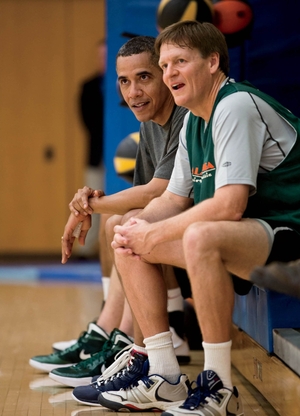
Michael Lewis, Terry Gross, President Obama


Okay, stop reading this and go on line to NPR and click on Fresh Air with Terry Gross and click on the Michael Lewis interview about his months shadowing President Obama. Then come back.

So, okay, you're back now.
Did you have the same feeling I got, hearing the details of the time Lewis spent with Obama, this is a guy you know?  He's the sort of guy you knew in college. He will never be a professional basketball player, but if he could have been, he would have preferred that to being President. He knew himself and his own abilities well enough to know he would be successful as President but not in pro basketball.

He is intensely competitive, but he "stays within himself," i.e., he does not try to do things he is not likely to succeed in doing. 

He understands what most Washington people learn quickly, that the blowhards like Limbaugh and Mitch McConnell et al who call him a socialist, or a racist,  or a closet Muslim or foreign born  Kenyan or whatever  the charge de jouris, they are not describing  him but themselves. 
He is not hurt by criticisms which pertain to a fantasized Obama rather than the real Obama.

He took a long time to realize that Mitch McConnell had no intention of cooperating with him on anything, that if Obama said black, McConnell would say white and that was his only agenda. When he finally saw the game, Obama thought, well, then McConnell will pay the price of looking obstructionist, but no, back in Kentucky, McConnell was celebrated.

I'm going to run right out and buy Vanity Fair and read Lewis's article.

It struck me that Lewis observed Obama is really a writer, at heart. He stands back and observes, for which he's been accused of being "aloof." 

And it strikes me that sometimes this nation gets a President who is better, far better, than we deserve.  It was that way with Lincoln. 

And that's something which on a certain level makes me very uneasy.  One of the things Lewis talks about is how strange Air Force One is. It has special bay doors which are meant to be big enough to allow for the loading of the President's coffin.  

It is an eerie and sobering reminder of what this man faces every day.
I'm old enough to remember Kennedy.
 And I grew up in the South.
There are haters out there. 
Let's celebrate him while we have him.