Wednesday, May 14, 2014

Al Franken: Best Hope for the Ninety Nine Percent


Mad Dog never thought Al Franken was all that funny. He could make you laugh, and some of his Saturday Night Characters were droll enough--the correspondent who carried his own satellite dish on his back into the field, but was always groaning in pain under its weight, the self esteem guru whose refrain, spoken into a mirror, "You're good enough, and dog gone it, people like you"--were funny one time, but they often got beaten into the ground. 

His radio talk show, launched to counter Rush Limbaugh fell flat. He simply could not contain his rage and he was reduced to calling Limbaugh and Bill O'Reilly big fat idiots, which, while true, was not funny.

But, as a Senator, he has restrained his rage and consciously striven to be not comic, and hearing him on NPR this morning, talking about the efforts of Comcast, Verizon and other big corporations to carve out a "fast lane" of internet traffic, leaving the hoi polloi to wallow in a slow lane, Mad Dog felt a certain hope rising.

This is a man who has grown. With Barney Frank gone, Franken might actually fill that gap. And that is a big gap to fill.

When Democrats are inviting speakers to spot light, Franken should be the go to guy, and he would hold his own with Chris Christie, Mitch McConnell and John Boehner and all the rest of that sorry lot. 

Mad Dog continues to yearn for an answer to right wing talk radio, beyond Jon Stewart and Colbert (RIP).  He still thinks a puppet lampoon a la "Spitting Image" would be ideal for the internet and he thinks a radio show should be carefully crafted to galvanize progressive opinion.

But, for now, in the absence of an embrace from the Democratic party for his schemes to shape public opinion, without funding or support from Mr. Soros, or the MacArthur foundation, Mad Dog will simply hope Mr. Franken can provide some relief.


Sunday, May 11, 2014

News Flash: The Supreme Court--Just Politicos in Fine Black Robes


How many years has it been that Mad Dog has claimed the Supreme Court of the United States is simply a political organism dressed up to look impartial and cleaving to the arcane body of work called "The Law?"

But, of course, Mad Dog has had to admit he is simply a humble citizen, untrained in law, unversed in history, and voicing an opinion based only on what he can find on the internet, which includes the opinions of the court for every year, on every case. 

Now, however, we have experts, professors of law, professors who "study the court" quoted in today's New York Times, saying, in those tempered academic tones, essentially just that.

Mad Dog's argument has been simple: If it is possible for someone untrained in the law  to read a single paragraph summary of any case before the court and to predict with greater than 90% accuracy how the court will divide on the case  then one must conclude the court is not being guided by different interpretations of the law,  but by the very measuring stick used to predict the outcome with such unfailing accuracy. If you can say, well, this case basically pits the interests of the rich or the powerful or the authority against the claims or interests of the underclass, the poor or the weak and Justices Alito, Scalia, Thomas and Roberts will vote for the ruling class in every case, then one must accept that  is what guides the four horsemen of this conservative apocalypse.  Let us always vote establishment.  

So, if it's a schoolboy holding up a derisive poster, thumbing his nose at the principal of his school when she tries to force students to support the "Olympic movement," or if it's the case of a rich corporation trying to claim the right of free speech as an individual, even though there may be stockholders of that corporation who disagree with that speech made in their name, or if it's a law passed by a predominantly black city (Washington, DC) to oppose the authority of the  powerful National Rifle Association and claim that the 2nd Amendment does not guarantee an individual the right to a gun but only guarantees guns to members of a well organize militia--if in any and all these cases you have only to identify who is in power and who is not, to know who this court will embrace, then law has nothing to do with it.

We really should allow each President to appoint one new justice each year of his presidency; and we should allow only the mostly recently appointed  nine to vote.  Then we'd have recognized what the court really is--just another political animal in Washington, which should be at least indirectly controlled by the electorate, to reflect the will of the people.


Saturday, May 3, 2014

The Electronic Medical Record and Quality Control: Coming to a Doctor Near You


We all want high quality medical care. Does anyone out there desire low quality care?
It's one of those things a Senator can say, like "freedom" or "prosperity" and be assured of smiles all around.

And we all agree if a man bills for a service, whether he is a doctor or a mechanic, he ought to be able to show the person or organization which pays him that he actually did provide the service.

So far, everyone is happy.  Freedom. High quality. No fraudulent billing.

The advent of the electronic medical record has meant when you are sitting in front of your doctor in the exam room he is no longer looking you in the eye, or staring at the ceiling or out the window, or at the clock on the wall behind your head: He is now typing furiously on his computer throughout your interview.

But what is he or she doing in that computer he or she is so absorbed with?

The doctor  might be entering data, so he can refer back to it next time you visit or call, to track symptoms, laboratory results, to  track progress or lack of it.

Actually, what he is likely really doing is entering in "quality measurements."

What this means is he has asked whether or not you have had a flu shot and checked off the box that he has asked,  and he checks off a box to document he has told you to get one, never mind if you said "No."  There is another box for whether or not he has told you to stop smoking and another for "lose weight." Check those boxes. Doesn't matter whether or not he mumbled "Good" when you said you were still smoking. The important thing is did he ask and did he check the box. If he said, "ohthenyoushouldstop," when you said yes, then  can check that box, too. More credit.

And there is another box for "family history."   

Why would the powers that be care about whether or not the doctor asked about your father's health?  Actually, there can be valuable information about you in your father's history. 

Until we have a map of everyone's genome in your medical record, the low tech family history is the next best thing. Suppose, for example, you have a high cholesterol. You may be on the launching pad to start a statin drug to bring it down. 

Unless!  

Unless, it turns out your father also had a cholesterol of 300 and so did all his brothers and sisters and so did his father and every single one of them lived to be ninety-nine. Then we do not treat your cholesterol, and you are off the hook. We recognize there is something we don't know how to measure which is protecting your family against that high blood cholesterol, which, in your family,  does not stick to and penetrate the walls of your blood vessels but simply slips by the endothelium like a greased pig sliding down a water slide. 

Now, if your doctor should type in all that information in the "free form" box of your electronic medical record, he gets no credit at all;  but if he does ask and  fails to check the box in the fifth screen of "family history" then he is practicing bad quality medicine. If he scrolls through the screen and finds "father" in family history and clicks the box next to "father" then he has practiced stellar quality medicine and Medicare pays his employer. 

Of course, the doctor may not have asked about your father's cholesterol at all. No matter. All that matters is that he has found the box next to any "first degree relative" and checked it, which is to say, in the eyes of the bean counters, he has done a "reimbursable family history."  High quality medicine right there. 

Multiple that by two dozen other check off boxes on several score of screens and you've got yourself a medical office visit that is easy to score for "quality."
Van Gogh Field with Crows

Remember when you took a test in school and they gave you a multiple choice test about Walt Whitman or the Civil War or geometry or the art of Vincent Van Gogh?  These are not subjects which lend themselves to multiple choice questions, unless you get to some pretty superficial questions, but that multiple choice sheet can now be run through a machine and graded in an instant--even in the 1960's the teacher could lay down a perforated score card over your test answer sheet and grade it in less than a minute.

All of this scoring is about a system which can be graded and "quality controlled" mindlessly by someone who has not the least idea what actual good quality is. 

Can you imagine what playing such games does to the mind of the person in the white coat sitting in front of you? Is he now concerned about your cholesterol,  or morphing into  a mindset  closer to that of a teenager playing a video game?

What we are seeing now is that some minimally trained "health care providers" look better than physicians who have gone through some pretty rigorous training at some very intensive programs, stayed up long nights and undergone ruthless grilling by their professors.  Is the physician's assistant who scores higher on the computer searching his electronic medical record really just more high functioning than the doctor who scores low because the doctor did not check off that box but instead got into the details of your father's actual history?

There are likely ways to judge some physicians by computerized records, but that ain't what we got now. The minds of the "quality control" specialists feeding those bits into their computers are as empty as last year's bird's nest.

Back in the day, we used to say, "The better the surgeon, the worse the note."  There did seem to be that connection--the really wonderful surgeons, the guys you wanted doing surgery on you or your family were fantastic in the operating room, but desultory writing up what they did. Some of this changed when surgeons could dictate their chart notes, but even then it was often a difference between guys who played a good game and those who simply talked a good game.

And your doctor, now an employee, has to check off those boxes or face his employer in a disciplinary meeting which could end in his dismissal. How do you think that affects what he does when he is in the exam room with you?

"Quality control."  In medicine, a work in progress. Done about as well as the healthcare roll out. Well meaning people, not up to the task. And this is not Obama's fault. This has been in the works dating back to George W. It's embedded in government workers and in insurance company workers and in academics who have carved out their niche and drawn their salaries becoming "experts" in quality assurance.  If you cannot do, teach?  If you cannot practice high quality medicine, get a job dreaming up metrics.

Billy Bean of "Moneyball, " where are you now when we need you?

Monday, April 28, 2014

Duke Lacrosse and the American Campus: Exception or Rule?


Duke Lacrosse Scholars 
Stanford Undergraduates Contemplate Charles Darwin
As the "student athletes" at Northwestern cast their votes about unionization, a new book about Duke University and its relationship with the "student athletes" of its now infamous lacrosse team has hit the bookstores and the Kindle screens. 

It's not a pretty picture.

What is really astonishing about college athletics is that so many millions can be so blind to its hazards.

A former president of Princeton, William Bowen, has written in "The College Game" and "Reclaiming the Game" about the poisonous effect on the integrity of academic scholarship of merging commerce (in the form of college sports) and academia .

The reigning opinion has been that college sports may not be central to the mission of an academic institution,  but it is a harmless way to raise cash for cash strapped institutions. The impact of admitting 100 people to play football and 50 to play basketball on a student body of 10,000 is minimal.  In the Ivy League, where there are smaller class sizes and far more teams (lacrosse, swimming, volleyball, equestrian, soccer--an average of 15-20 sports teams) the impact is actually higher, there you may have 300 or 400 people on campus to do a sport,  out of a class of 1000. 

All this  brushes by the story of Lenny Moor, who, when called on in class,  told his professor, "My name is Lenny Moore. I carry the ball. I don't answer no questions."  Does having people on campus who reject the value of scholarship and academic effort really injure the academy?

Does filling a stadium with 100, 000 paying fans at Ann Arbor really harm the integrity of a great university?  What is the harm of smiling fans in blue and maize and pom poms and little kids in the college colors having a good time at the football game?

The president of the University of Chicago, long ago, said he could not abide the thought of sending a team of 19 and 20 year old boys across the country to California to play in a game which consisted of chasing an inflated bladder around a field. His school ultimately eliminated football. Johns Hopkins does not have a football team, but it does have a lacrosse team. The Ivies all have football teams.

There are, of course, stories about football players raping young women off campus at or after visiting local bars.

But the real issue is the difference between a culture of physical and mental contest living alongside a culture of the mind. We value diversity on campus, and perhaps we should value the diverse cultures of athletes and engineers.  Why then, if we value these different perspectives, do we not include in that mix tradesmen, farmers, assembly line workers? 

Faculty, particularly in the humanities have always been something of an impoverished priesthood, suffering the insults of materially successful people while the scholars pursue their arcane interests. Of course, faculties are now also filled with "stars" who command great salaries and interest free mortgages at some universities, who cut rap albums and who appear on TV shows. 

Mad Dog has no real insight into how healthy life is on America's college campuses  today. 

But he has his doubts.

Tuesday, April 22, 2014

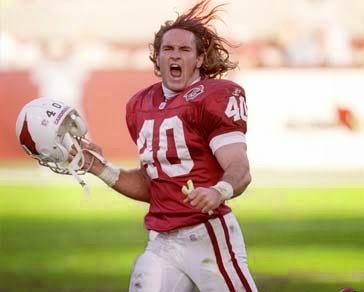
Pat Tillman: The Desire to be a Hero


 Ten years ago, Pat Tillman, a National Football League player, who joined the Army after 9/11, was shot to death by mistake, by his own compatriots in a friendly fire incident. 

This raises, for any American, the question of how can you best serve your country.  

Tillman wanted, it must be supposed, to be a hero. That is nothing to disparage. Men become doctors and surgeons and astronauts wanting to be heroes.  Wanting to be a hero is not a bad thing. 

Tillman made a genuine sacrifice, giving up a lucrative NFL career, a life of violence on the field but luxury off it. For many of his fellow Army recruits, the Army was the best job, financially and socially they could get. Not true for Tillman.

As most of us understood his decision, he was motivated by a desire to really make a difference in the effort to seek revenge or simply to prevent another terrorist attack. He wanted to take the fight to the enemy, not just go on living his safe, comfortable life.

But he was killed through the incompetence of the American military.
When you think about it, more American soldiers have likely been killed through the incompetence of their officers than through the effectiveness of their foes. How can anyone say something so outrageous?  But consider this: More Americans were killed during the Civil War, by a country mile, than in all other American wars combined. 

And for the most part, most of those Americans were killed because officers and generals were still sending waves of men running across fields at entrenched enemy riflemen who could shoot them down from 80 meters away.  The generals simply did not appreciate that the rifled gun barrel meant that heroic charges across a field or up a hill were a senseless waste of life,  once the technology of weaponry changed. Nobody would send a company of soldiers running across a field against machine gun fire today. That would be seen as gross incompetence. It was no less incompetent during the Civil War, just more widespread and  more widely accepted. 

So, yes. Mr. Tillman joined the masses of American soldiers killed through the incompetence of the American military.

Which is not to say the American military is, overall, incompetent.  Despite many sizable incompetent plans, execution of plans, the American military has often achieved its ultimate mission, by accruing overwhelming numbers and force against a smaller opponent.  Grant had more men and he used that advantage to grind down a more agile and more ably led opponent.  Maria Sharapova, in the tradition of Russian warfare compensates for a lack of elegance and finesse with grinding power and tenacity. The American Army can execute the occasional attack effectively.   Just ask the Iraqi soldiers who fought the American army  during  the first gulf war, or ask the soldiers who fought with Richard Winters in Easy Company of the 101st Airborne. 


But all too often the command simply does not ask enough questions, or play smart, and substitutes bravado for intelligence: consider the chaos of the Normandy air drop  and the entire game plan for the war in Vietnam. 

If you want to be effective, why would you put your life and your own decisions in the hands of American military officers? When the Vietnamese, or any other underdeveloped country facing the force and bluster of the American military looks at our Civil War, they must shake their heads in wonder. Why would you waste lives and military effectiveness in displays of senseless valor, when you can ambush, and then melt away and kill by a thousand cuts?

So how can you react to Al Qaeda terrorists blowing up buildings in your cities?  How does a citizen who wants to react take effective action in behalf of his nation find a way to do this,  if he cannot trust his leaders to provide an outlet?

Mad Dog does not have the answer. 


War on Terror; War on Drugs, War on Cancer: Fantasy in American Policy Ideology

 Kima: "You suckers just kill me: Winning the War on Drugs-- one police brutality case at a time."
Carver: "Girl, you can't even call this a war."
Kima: "Why not?"
Carver: "Wars end."
--The Wire

"If I could free all the slaves and save the Union, I would do that. If I could free none of the slaves and save the Union, I would do that. If I could free some of the slaves and leave others alone, I would do that, too."
--Abraham Lincoln


When Lincoln finally issued the Emancipation Proclamation, he gave legal cover to what was already happening in the field--as the Union army advanced, slaves left their bondage, fled their "owners" and followed their liberators. 

Lincoln was afraid if he declared the Civil War was actually about freeing the slaves that half of his Union Army officers would throw down their swords and quit and all the border states--Maryland, Kentucky, Tennessee--would join the Confederacy. Southern Maryland was very much slave country. There were riots in Baltimore over emancipation and abolition. The Maryland legislature was about to vote to join the Confederacy when Lincoln sent in the troops to send the legislators home.

Lincoln issued the Proclamation in September. By January, in his annual address to Congress he had seen the true importance of that document:

Fellow-citizens, we cannot escape history. We of this Congress and this administration, will be remembered in spite of ourselves. No personal significance, or insignificance, can spare one or another of us. The fiery trial through which we pass, will light us down, in honor or dishonor, to the latest generation. We say we are for the Union. The world will not forget that we say this. We know how to save the Union. The world knows we do know how to save it. We -- even we here -- hold the power, and bear the responsibility. In giving freedom to the slave, we assure freedom to the free -- honorable alike in what we give, and what we preserve. We shall nobly save, or meanly lose, the last best hope of earth. Other means may succeed; this could not fail. The way is plain, peaceful, generous, just -- a way which, if followed, the world will forever applaud, and God must forever bless.


As Lincoln said in his second Inaugural Address, everyone hoped for a less drastic solution to the problem but there was none to be had, and the war came. Of course, not everyone hoped for a less drastic solution--the slaves and the abolitionists hoped for the most radical solution, complete abolition of slavery in both the slave states of the South and in the new territories. 

Lincoln was, hands down, our greatest President, but even he could not see how a powerful will for doing the right thing could overwhelm even entrenched wrong. After he issued the Proclamation he went before Congress and told the representatives there could be no ducking destiny. We had to either gloriously succeed or meanly concede defeat, and if we lost, then the last best hope on earth would be lost.

That document, limited as it was, changed the course of the war--England and France, missing Southern cotton dreadfully, with cotton mill workers left idle by the Northern blockade were about to intercede and the South would have won independence, just as the French intervention won the Revolutionary War for the American colonies. 

But anti slave sentiment in England was crucial and when Lincoln made the war a war to end slavery, that ended all talk of intervention. It turned out to be a master stroke, necessary but not sufficient to win the war.

We do not have a war with armies in the post 9/11 age. Like Lincoln, President Obama faces a new phenomenon in history, and like Lincoln, he wants to use the tools of the past to fight a new reality. As Radio Lab notes, in its examination "Sixty Words" a legal document, written by a George W. Bush lawyer in the White House has served to justify, legally, the "War Against Terror," voted through Congress. No declaration of war has been voted through Congress since World War II. There are simply no real circumstances appropriate. A nuclear war between the USA and USSR would not have allowed time for a declaration of war.  All the other wars have been undeclared.  Korea was a UN "police action."  It looked a lot like World War II, with armies and air forces battling for territory but it did not end in a peace treaty ceremony. Technically, it's not over.  Vietnam was justified by the Gulf of Tonkin resolution, not a declaration of war and Iraq and Afghanistan were justified by the resolution writing by the Bush lawyer to say the President could do what he damn well please to protect the USA against terrorist, i.e. stealthy, attacks. 

Those 60 words are just words, just lawyer games and fool nobody. They cannot compare to the Emancipation Proclamation, which actually meant something. 

We are operating now in a world of practical action taken as a police force takes its action. Someone is about to hurl a bomb, you don't read him his Miranda rights--you shoot him. 

The time for talkers has past.

Of course, that has left us with problems like Guantanamo. 

Too bad the Congress was too cowardly to oppose Iraq, and even Afghanistan, after they got Bin Laden.

We will see how useless those lost lives in the War on Terror have been as we see Iraq and Afghanistan sink back into their respective morasses.  

We needed to get Osama. For that, we needed bases in Afghanistan. But once that was done, good riddance to bad garbage.

Bring 'em home. Don't pretend we were there for any other reasons. And no document written by lawyers will protect anyone. The generals at Nuremberg all had their documents. Didn't help them. Soldiers are not governed by words as much as by bullets. 

Saturday, April 19, 2014

Jill Lepore Deconstructs Fear and Loathing of Elizabeth Warren

Elizabeth Warren

 Jill Lepore, in the 21 April New Yorker fulfills the highest aspiration of the literary critic in her review of Elizabeth Warren's new book, "A Fighting Chance," by placing it in an historical context. Lepore sometimes exasperates Mad Dog with strained incorporation of historical antecedents to modern events, but in this case she uses the life and work of Louis Brandeis to enrich our appreciation of what Elizabeth Warren is all about.

She begins with Warren's own stump speech, which terrifies and infuriates all the self made men of the right wing, the Republican part, the right wing talk show set. 
"There is nobody in this country who got rich on his own. Nobody, You built a factory out there, good for you. But I want to be clear. You moved your goods to market on the roads the rest of us paid for. You hired workers the rest of us paid to educate. You used other people's money. You built a factory and turned it into something terrific or a great idea--God bless! Keep a big hunk of it. but part of the underlying social contract is you take a hunk of that and pay forward for the next kid who comes along."

This of course, gets to the heart of the Right Wing's fantasy about how much they deserve all their wealth and how nobody else is entitled to any share of it.

Warren is careful not to denigrate the effort of the man who took risks to build the factory or launch the idea, but what she is adding is the big "But."

Brandeis argued in a famous brief that women ought not be put in a position of having to work 12 hour days or lose their jobs. Brandeis argued in "Other People's Money" that monopolies of capital captured by big banks resulted in great harm, no matter how legally they may have been won. Three New York banks controlled more wealth than all the property in the twenty two states lying west of the Mississippi. Even if the bankers were angels, which they most assuredly were not, this could not be good for a democratic republic.

Rush Limbaugh would, of course, cry foul. This is not how the "game " is played. You cannot change the rules, especially if those changes disadvantage the winners.  And, anyway, the winners deserve to be in control.

Certainly, Mad Dog is familiar with the psychology. Mad Dog looked out from the chemistry laboratory window as his fellow college students danced by, in togas, on their bacchanalian way, with their arms around the girls they would take to bed,  and he heard his fellow pre-medical students mutter. "They're getting theirs now, but I'll get mine. And when I graduate from medical school and they are whining about how tough things are for them, it'll be my turn to laugh." The ants and the grasshopper.

And Mad Dog thought. Yes, you are working really hard and sacrificing the present for the future, but you are doing it in an Ivy League college, and you are working in a college lab paid for by someone else, and you are going back to sleep in your dorm room, paid for by somebody else--your parents, your bank, taxpayer dollars. 

When Mad Dog opened his office to practice medicine, he was lucky enough to not have to take out a loan. He had written a book which provided the capital. He was lucky to get it published. He had worked hard writing it, but he was still lucky. And the success of that book depended every bit as much on other people who sold it as on his own efforts.

Mad Dog had to hire a secretary. She had never finished high school. She answered the phones, made appointments, filed charts, took phone messages, called in prescriptions, created bills for the patients, collected their payments, billed Medicare, entered the payments into the computer system, and when she went on vacation the income in the office plummeted because the temporary worker replacement could never approach her productivity.  When the secretary was out sic, Mad Dog, thought, "I don't need her. I can do all this myself. I'll just work harder."  But Mad Dog learned quickly, that was a fool's errand.

Mad Dog paid her the same check every week no matter what. if she missed time for a doctor's appointment, had to take her husband to the doctor, had to leave early for a nightclub gig--she was a country singer on the side--Mad Dog still paid her in full. No time clock. When she asked why he was willing to do this, Mad Dog observed she often stayed late to finish up work, and he hadn't paid her any more for that. He paid her for doing the job, not by the hour. 

She was not above drawing her own lines:  She left for lunch at the stroke of noon, even if a patient was finishing up and on her way to the window and could have paid her bill right then. Lunch time was sacred.  She would not call repairmen for the photocopier or the computer or the telephone system. That was not her job.  When she finally left after 20 years, a new secretary did all that without a murmur.  But the fact is, that employee was essential to the financial success of Mad Dog's practice. Patients did not come to the office to see the secretary, but had she not been there, they could not have been scheduled at all, and no money would have been collected for Mad Dog's efforts.

So Mad Dog knows Warren is correct: Every self made man stood on the shoulders of others. Even Coltrane, who practiced hours every day, had to be taught the saxophone by someone and someone had to set up the clubs he played in. 


Jill Lepore
Lepore includes a scene from a dinner with Larry Summers who told Warren she had to decide whether she wanted to be an insider or an outsider. To be an insider, he told her, she could not break the rule: Don't criticize other insiders. Doesn't that just say it all about Larry Summers and the stupidity of those who think they know what the rules are and ought to be? I was surprised Lepore did not mention Lincoln and his shrewd and brilliant idea that he needed his critics close at hand, in his own cabinet. 

People like Summers, and Kissinger before him, always want to play the savant. The fact is all they know is how to promote themselves.

Lepore sums up her own take on Warren as she hurdles through the last page of her analysis: 1. Most candidates elected to office in the United States in the past two centuries abandoned their children.  2. Warren had better have the sense to turn a deaf ear to political advisers who will try to do with her what they had done with all others: "Include, when telling the story of their lives, gauzy intimacies, silly-little-me confessions of domestic ineptitude, stagy performances of maternal devotion, and the shameless trotting out of twinkle eyed tots."

Warren has fallen into that trap once before, as she ran for U.S. Senate, but who can blame her? She had never run for office before. She needed to trust someone and people were telling her how to win in the real world where the voters were not Harvard undergrads.

In the end, Lepore comes up with the most powerful image and statement of all. Warren tells about how Warren went to her grand daughter's crib and scooped the baby  up and held her, "Not because she needed it, but because I did."
And Lepore observes: "Her brief is really about the abandonment of children, not by women who go to school or to work but by legislatures and courts that have allowed the nations social and economic policies to be made by corporations and bankers. Writing about her children and grandchildren--rocking that baby--is more than the place where Warren leaves Brandeis behind. It's an argument about where our real debts lie."


Louis Brandeis
Where Our Real Debts Lie