Sunday, February 23, 2020

Bernie Sanders and Why We are Not Finland


Reading Michael Booth's "The Almost Nearly Perfect People"  ethnograph on the Scandinavian countries, Mad Dog felt a wash of memory and experience surge over him.

Until a year ago, Mad Dog's only experience of Scandinavia had been mostly with people of Scandinavian descent he knew in America, or the odd Finn or Swede he ran into during his university years. 

Mad Dog did get pushed into a trip to Norway in 1980, because his wife's mother was living in Oslo while her husband worked on the North Sea drilling platforms Mobil Oil was building there. This was years before Norway was actually able to extract oil from the North Sea, before it became the Saudi Arabia of Scandinavian, awash in oil wealth.

All Mad dog knew about Norway was it had fjords and blonds and he had read "The Moon Is Down" Steinbeck's rendition of the Nazi invasion and David Howarth's astonishing "The Sledge Patrol" about the resistance in Norway.

Mad Dog objects to going places where they don't speak English, but his multilingual wife assured him all the Norwegians spoke English because it's Scandinavia and not to worry. 

Nobody spoke English in Norway, at that time, as far as Mad Dog could tell and neither he nor his wife spoke Norwegian, although his wife spoke pretty good German, which got you a lot of hostile stares in Norway, and having read about the German occupation, Mad Dog knew why. 
More Norwegians, of a certain age, spoke German, but they didn't like Germans and Mad Dog's wife could easily pass for German, visually, and Norway was fun, but not a place Mad Dog thought he'd want to live or visit again any time soon. 

Last year Mad Dog got hauled off, once again, to Scandinavia where, he was, once again,  assured everyone speaks English, but this time it was mostly true.  Over the past 30 years, apparently,  English is taught in schools from Iceland to Finland and most of the kids speak pretty good English, which goes to show how good Scandinavian education is, as Mad Dog took 4 years of French and can barely order a meal in French, but these kids were very conversant. In fact, when a Finn talks to a Dane, they typically use English. 
During his brief excursions from the safety of his Viking cruise ship, Mad Dog was able to ask English speaking Norwegians, Danes, Swedes and Finns what they thought of their healthcare systems. Their startled looks told a tale. "Our health care?" Why would anyone ask about their healthcare? This was like asking, "How do you feel about your mother?"  Healthcare just IS in Scandinavia. It's there for you and it's good the way your mother is good when you stagger home with a fever or a bloody nose. Whenever he could, Mad Dog would peek into a clinic door, where he noticed the reception area did not have that first desk, the barrier to all American patients, where they ask for your health insurance card. 
In these government clinics there were no money changers, no business offices, no secretaries processing insurance forms, just nurses and doctors.


Across the street from Mad Dog's childhood home in the Washington, DC suburbs, lived a family named Juntilla, from Minnesota. The father had been shot down over Germany during the war, and was now a lawyer for the Justice Department and his main case seemed to be a lawsuit against "Playboy" and the fact it was mailed through the United States Postal service, which meant the Juntilla house was the place to be for all the neighborhood boys because, apparently, the lawyer needed to do copious background reading for his case, and there were stacks of "Playboy's" in the basement.

They also had a drop dead gorgeous daughter, who most of us ignored until she demonstrated she could throw a baseball adequately, and as our tenure was from age 9 to age 18, we didn't really see her until she got to be 13 and we were 18 and about to go off to college.  Then we asked each other: who is that girl we thought we knew?

Mrs. Juntilla did not work. She never got a driver's license, but she drove her VW Minibus all the time, as every suburban housewife drove their kids around, and she smoked and looked amused as she talked to the neighborhood boys who hung out on her couches and in her kitchen. 
Mrs. Juntilla, as I remember her

She was the only mother in the neighborhood who was the least bit attractive, physically, and her blond, high cheekbone looks placed her somewhere between Grace Kelly and Eva Saint Marie.  She looked glamorous, but she did not act glamorous. She grew up on a farm and everything about suburbia seemed to amuse her, as life was just too soft and comfortable and she could not believe the complaints she heard from the other stay-at-home mothers, who were living on easy street but still dissatisfied. (The fact is, another neighborhood housewife drank herself to death, and one up the street was wheel chair bound with multiple sclerosis, and two died of breast cancer, but overall, most of the women had typically comfortable, if mind numbing, suburban lives.)
Mrs. Juntilla made an exception for Mad Dog's mother, who taught at the high school and did not get home until five o'clock most days, which was one reason Mad Dog hung out at Mrs. Juntilla's house, although he was glad for the excuse because Mrs. Juntilla was very cool. She would have been right at home at Woodstock, although she would have been unimpressed by it. Bathing in the nude? Marijuana? How is that different from her Minnesota farm?

She told stories about the animals on her farm. Chickens, she said, were stupid. There was just no getting around that. But pigs were intelligent, if uncouth, and goats were just very weird. You could not fool a goat. Goats watched you and you had to respect goats.

Mr. Juntilla brewed homemade apple cider, hard cider in his garage with the enthusiastic assistance of his neighbor who worked for the CIA, and another who owned a bar.  He lay on his couch on weekends, and read "Catch-22" and laughed until tears rand down his cheeks and when Mad Dog asked him why he liked the book so much he looked Mad Dog over and said, "Because this is the closest thing to what it was really like I've every read."

I never heard Mr. Juntilla speak Finnish, but whenever it snowed, which was maybe ten days a year in the DC suburbs, all the Juntillas got on their wooden skis and wool Finnish sweaters and they skied down the street to the highway at the bottom. You could do that then because the county only had 10 snow plows and the street remained unplowed for days, or until it got warm and melted.

The next time Mad Dog thought about the Finnish was as he was finishing his medical training and his department had a Spring party at a park and Viekko Koivisto, one of the young faculty, told Mad Dog he was moving his family back to Finland. 
"But Viekko," Mad Dog expostulated, "You're the most successful guy we've got! You've published more and the stuff you've done is more important than just about anybody else. How could you leave? You're a star."

Viekko allowed himself a faint smile and nodded toward a gaggle of children chasing each other around a set of swings and jungle gyms, laughing, shouting, spraying each other with squirt guns. 

"Look at those kids," Viekko said. "Can you tell me which ones are mine?"
Mad Dog looked at the kids and guessed maybe the tallest, blondest kids were Viekko's but they might have belonged to Hans, a German fellow, or Kurt, who was from Texas or Jan from the Netherlands. 
"No," Mad Dog admitted. "I give up."

"That's my point," Viekko said. "I've got to get them home before they forget they are Finnish."

Reading Booth about Finland, Mad Dog learns that the Finnish school system is rated by some international program to assess the educational systems of about 80 countries, and it always comes in first or second overall, and usually first in math, language and analytical thought. They do this, starting kids in school at age 7, keeping them in class only 4 hours a day, assigning little homework and allowing for summer vacations. They do this without much formal testing until kids are about 18.

They do this with a system which is entirely government run, with virtually no private schools, which is free through college and even graduate school

They do this by making teaching jobs highly prestigious, requiring master's degrees in programs which have 10 applicants for every space. They do this by making sure every teacher is constantly re educated, updated on new material on new ideas about effective teaching techniques and thoroughly and frequently evaluated. 
Booth, raised in England asks the reader to consider the "psychopaths and social misfits" who served as teachers in the UK or America. 

The Finns ensure that no matter where your school is, in Helsinki or in the far reaches of the deep forests, your learning experience is identical. About 1/3 of all students get personal tutoring to bring them up to snuff whenever they fall behind in math or language or any subject. No child is left behind and every child is observed.  They do this spending less on each child than we do in America and they do this for every child.

Mad Dog thought about a book club the Democratic Party organized in Exeter, New Hampshire. A lovely lady, in her fifties, showed up with a school text book she got from her high school son, from which she learned we have 3 branches in our federal government. 
Once Mad Dog managed lift his jaw from his chest, he zoned back into this lady's explanation of how the three branches have more or less separate functions and there is this thing called "checks and balances." She seemed delighted to learn all this, at age 50 something, having graduated from a public high school 30 years earlier and never, apparently, having been taught any of this. 
Mad Dog was about to ask her what branch of government this lady thought the upcoming Presidential election was about, and then he thought about asking her if she had ever heard of "The Constitution,"but, before he could choose which question, he was savaged by a swift and painful kick in the shin under the table from his stalwart and ever vigilant co conspirator, with whom he canvassed neighborhoods before every election. His co conspirator smiled daggers at him, and Mad Dog refrained. 

As Booth relates, when he tried to interview Finnish adolescents, they were much the same as teenagers in the States or Britain: hormonal, monosyllabic, distrustful, about as cooperative as a prisoner being watched for signs he is a stool pigeon.  But when they were tested by the international assessment folks, they do spectacularly well.

But why? Are they genetically smarter?
Talking to a variety of people who are supposed to know, or at least, who are supposed to have theories about this two things come up:
1/ There are virtually no immigrants in the group of Finnish students to pull down the average scores.
2/ The population is committed to the idea that education should be about education, not status. Ergo the absence of private schools. 
Jobs, careers, opportunities are not based on whether to went to the "right" schools, which in every country which has a "right school" really reflects class advantage. 

Can you imagine an America, where the upper class would give up its bragging rights, of saying, "Oh, my son is at Princeton," or Harvard, Stanford, Yale etc?

We do not embrace equality in America. We thrive on inequality and striving. 
The "American Dream" whatever that is, is all about "rising above" origins to make yourself bigger, better, richer, more privileged than the peons from whence you came.
Or, at the very least, they will be living at a higher rung than Hispanics, Blacks or dark skinned immigrants.

This is the problem Bernie has. The poor cleave to the idea that someday they will be rich, they will be riding around in the golden carriages, waited on by servants and vacationing in the Caribbean. Cinderella. Snow White. Aladdin. Disney's princesses, selected from the humble, living in toil and squalor. But does Disney ever look back at the folks Cinderella left behind? Does anyone care about whatever became of the Seven Dwarfs? Of course not. They are just dwarfs.  Oh, no, they disappear. All that counts is Snow White or Cinderella has made it big. 


In Finland, school children are taught to not call attention to themselves; do not try to steal the spotlight. This is true, to a greater or lesser extent in Iceland, Norway, Denmark and Sweden, in about that order.


We the people, in America,  love a pecking order and Bernie promises to destroy that. 


Monday, February 17, 2020

Ray Buckley Instructs: Fighting the Last War


The Rockingham County Democrats met for their first post primary get together.


The chairman of the New Hampshire Democratic Party, Ray Buckley, spoke.

Mad Dog had something of the sensation he got listening to Joe Biden's first rally in Hampton: He found himself just hoping Ray could make it to the end of his sentence.

If affability won elections, the Democrats would have no worries in New Hampshire: Ray chuckles his way through his remarks, fields a phone call from his mother and generally sprinkles smiles around the room like fairy dust.

But when a woman asked Mr. Buckley for three talking points about Governor Sununnu, he was unable to provide any.  "We're working on those. I wouldn't want to provide them to you piecemeal."


Someone else in the audience suggested "Veto Sununu."

It went downhill from there.

Someone remarked he had canvassed for 3 months before the 2016 election in and around Hampton and never saw a single Trump canvasser. "We flooded the zone. Must have outspent Trump 100 to 1, at least as far as canvassing went,  but after all that, Trump lost Hampton by only 100 votes. "So how effective was canvassing?"

Well, if we hadn't done all that ground game, Buckley replied, Trump would have won in Hampton.  Dems didn't do enough ground game in Pennsylvania and lost there.

That's the way it always is with the NH Dems. If they get blown away as they did in 2010, well that was just a Red Wave, a national sweep New Hampshire got caught up in. But when the Democrats win, oh, that's because of all the local efforts, the door to doors.

"But where is the data on that?" another woman asked.
"Oh, it's out there," Ray waved vaguely.

Gary Cushing, head of the Seniors wing, mentioned that in his neighborhood he really could not "talk to his neighbors" as Ray suggested was the winning strategy because he would "disrupt the delicate balance" of sensibilities in the neighborhood, where neighbors who harbored different political opinions avoided conflict by sticking to safe subjects.

Another man observed that suburbs are places where people live in isolation, and they don't like people pounding on their doors. Block parties or pig roasts might be effective. Trump, after all, does rallies which foster a sense of community.

Another Dem asked again what we could say about Sununu, and Ray alluded to the Democratic party as a coalition of disparate individuals in which everyone has his own opinion. 

But it doesn't have to be that way. Dems could agree to "message discipline," a woman, who turned out to be a marketer, observed. 

Mad Dog had recently watched a history show on Netflix about the years following World War One, during which the United States Navy tried to figure out how it would win the next war. Navy brass was composed of men who had come up on battleships and destroyers. The idea that a tinny airplane might be able to drop a bomb or torpedo and sink a ship struck them as ludicrous. That's just not how naval battles are won, have always been run. And don't talk about submarines! What damage could a submarine do?


Ray Buckley is like that. The whole leadership of the New Hampshire Dems seems to be like that.  They fight the last war because they cannot imagine the next war.
They have no idea what hit them in 2016.

The woman who raised the issue of talking points talked to Mad Dog after the meeting.  "They were micro-targeting in 2016. Russians, who knows who. Send a Black man who lives in Chicago enough messages that Hillary thinks Black men are predators, it just might swing an election."

That is the woman who should be leading the charge in 2020, but she is not wearing the admiral's epaulets. 


Saturday, February 15, 2020

Identity Politics

Recently, Mad Dog was told by tweet he was a racist, which surprised him, although, Mad Dog always tries to remain open minded: Maybe, Mad Dog reflected I am at least a little bit racist.

The particular tweet in question arose because Mad Dog had expressed the opinion on Twitter that Mayor Pete, being homosexual, would have difficulty getting support in Black communities, which tend, especially in church going Black communities, to see homosexuality as an affront to God and Christian values. Mad Dog had read about this on line.  But attributing a belief to everyone (or even a preponderance of members) in a group might be, in some way "racist" to the extent that you are generalizing about individuals based on a group identity. 

Having marched for Civil Rights in the 60's and sung "We Shall Overcome" with Blacks and Whites, Mad Dog had not thought of himself as racist, but he can recall listening to Black Panther and Nation of Islam speakers inform him he was racist, and, in fact,  the the worst type of racist because although he pretended to be on the side of Black folks, he was secretly, or maybe subconsciously racist. Would he would allow his daughter to sleep with or marry a Black man? Would Mad Dog move out of a neighborhood if Black folks moved in?  
At the time Mad Dog had neither a daughter nor a neighborhood and he really hadn't thought much about either proposition, but the idea of inter racial sex did not much bother him and at least in college, the neighborhood seemed pretty mixed already.


Mad Dog had not actually given these tests of racism much thought, but as he considered it, he thought, well how free of racism am I?

He was particularly relieved watching "Avenue Q" to discover everyone is a little bit racist. 

https://www.youtube.com/watch?v=RovF1zsDoeM


PRINCETON
You see?!
You're a little bit racist.
KATE MONSTER
Well, you're a little bit, too.
PRINCETON
I guess we're both a little bit racist.
KATE MONSTER
Admitting it is not an easy thing to do...
PRINCETON
But I guess it's true
KATE MONSTER
Between me and you, I think
BOTH
Everyone's a little bit
Racist, sometimes.
Doesn't mean we go around committing
Hate crimes.
Look around and
You will find,
No one's really
Color-blind.
Maybe it's a fact
We all should face.
Everyone makes
Judgments...
Based on race.
PRINCETON
Not big judgments, like who to hire or who to buy a newspaper from --
KATE MONSTER
No!
PRINCETON
No, just little judgments like thinking that Mexican busboys
Should learn to speak goddamn English!
KATE MONSTER
Right!
BOTH

In his Letter from a Birmingham Jail, Martin Luther King mentioned the problem of having white "friends" who professed sympathy, but in fact preached patience and inaction to Blacks who sought their rights.  These whites were in some inactive way, back stabbers. Men who take no action can be as guilty as those who throw bricks.

For Malcom X, white people were ipso facto racist by virtue of their skin color which was connected to a tainted soul.

Mad Dog learns, from an irate tweeter, that because Mad Dog believes there is homophobia prevalent in the Black community, he is a racist.

Which caused Mad Dog to ask himself: How does he know about homophobia in the "Black community?"

And what is the "Black community" anyway?

President Trump told Black voters they live in squalor, crime infested inner cities and White Democrats, who claimed to be their friends, left them to fester and die there. So, vote for Trump.

Turns out, most Black Americans actually live in suburbs, if Professor Google is to be believed (Atlantic Monthly.)

But there were neighborhoods in Philadelphia which were almost entirely black and in one such precinct not a single vote for Mitt Romney was recorded when he ran against Barack Obama, as the Philadelphia Enquirer reported. At least one follow up study sent out people to survey the voters in some of these precincts and they could not find a single person who said he voted for Romney. 

"It's one thing for a Democratic presidential candidate to dominate a Democratic city like Philadelphia, but check out this head-spinning figure: In 59 voting divisions in the city, Mitt Romney received not one vote. Zero. Zilch."

We all recognize there are Black voters who will vote for Trump and there are always individual opinions and variations.  There were probably some Jews who supported Hitler for a while. But are you a racist if you ascribe to a group, to Blacks for example, an attitude prevalent in that group, allowing there will be exceptions?

This sort of thinking has been a topic in anthropological circles since Ruth Bennedict and Margaret Mead, where "the stamp of culture" was thought to shape values in individuals, and certainly some patterns of behavior are well known. 
Most Americans would not walk down the street buck naked: They have been conditioned and taught to embrace a stricture against public nudity.
But within groups. how much skin can be displayed and under what circumstances varies by individuals, although we still see discernible differences between groups. 

Neither Black nor White women go topless on public beaches (except at Hampton Beach) but Mad Dog well remembers the signs he saw posted in a predominantly Black high school in Maryland, "No see through blouses allowed." Apparently, teen age girls in that school had posed a problem for their adult supervisors. That was not a racial thing, Mad Dog thought, but a cultural thing. The Black adolescent girls in his upscale suburban high school would never have dreamed of showing up in class in a see-through blouse any more than their white counterparts.

(Of course, there were not more than 30 Black students out of 1500 students at his school and Mad Dog knew only two or three of them.)

So how where did Mad Dog get his idea that Blacks will not vote for Pete Buttigieg because he is homosexual? Well, on line. You have only to Google "Homophobia among American Blacks" and there are scads of articles about this observation, conviction, misconception whatever you believe.

But Mad Dog has attended Black church services occasionally, and he was struck by how very conservative the preachers were. Marital fidelity, chastity, fatherhood, placing family above all personal desires. It is true, Mad Dog has never heard a sermon in a Black Church about homosexuality being an offense against God, but Mad Dog has read about such sermons and he has not  seen denials of this position from Black ministers.

So, if you ascribe a certain belief to a group, are you racist or are you simply looking at data?

Suppose you said all Jews love money and place the pursuit of money ahead of love or patriotism? Well, yes, that might be the voice of bigotry.

Suppose you said, the Jewish vote will support a candidate who is strongest in his support for Israel? Well, that drifts toward a nasty ground. In fact, if you look at the Upper West Side of Manhattan, which may not be majority Jewish but surely has a substantial Jewish population, you find very little support for Israel's great champion in the White House.

Every pundit from Mark Shields to Sean Hannity thinks there are issues which resonant with members of certain groups:  Corn farmers in Iowa do not want to see requirements for corn ethanol in gas rescinded. 

But are Blacks a homogeneous enough group to have any "position" on homosexuality?

Mad Dog suspects subgroups likely do:  Church going Black folks may reject a homosexual Presidential candidate.

But how do we really know? 


Friday, February 14, 2020

My Lai, Hugh Thompson, Eddie Gallagher


My Lai


 P atriotism, heroism, toughness, American exceptionalism have got a lot of ink and on line time lately.

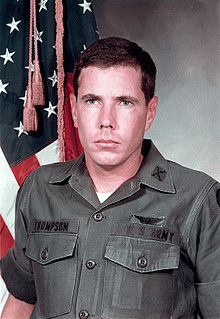
Consider the case of Hugh Thompson, Lawrence Colburn and Glenn Andreotta in their actions at the village of My Lai, Vietnam in 1968 and then consider Eddie Gallagher, who President Trump hailed as a true American hero, a tough soldier who fought for freedom and the American way in Iraq.

Charlie Company, led by Captain Ernest Medina and his subordinate Lt. William Calley,  swept through the village of My Lai, which was thought to be at the center of a Viet Cong brigade, but in fact was occupied by mostly women, children, infants and old men.  Calley, who spent much of his time in Vietnam trying to prove his toughness to his captain (Mediina), rounded up villagers, forced them into a drainage ditch just outside the village and started mowing them down with his M-16.


As Calley was murdering women and children in the ditch, a helicopter crew, Hugh Thompson, landed. Thompson demanded to know what Calley was doing and watched, horrified, as he fired into children in the ditch:


Thompson: What's going on here, Lieutenant?
Calley: This is my business.
Thompson: What is this? Who are these people?
Calley: Just following orders.
Thompson: Orders? Whose orders?
Calley: Just following...
Thompson: But, these are human beings, unarmed civilians, sir.
Calley: Look Thompson, this is my show. I'm in charge here. It ain't your concern.
Thompson: Yeah, great job.
Calley: You better get back in that chopper and mind your own business.
Thompson: You ain't heard the last of this!

Hugh Thompson


Thompson, not an officer,  got his crew back on the helicopter and started searching for villagers he could save and soon enough saw fleeing villagers pursued across a field by soliders from Charlie company. He landed his helicopter and ordered his two door gunners, Andreotta and Colburn to position themselves between the villagers who were diving into a bunker and the approaching soldiers.  He wasn't sure whether his crew would be willing to fire on American soldiers, but they promptly agreed.  Members of Charlie company approached and later testified they were pretty sure the gunners would have shot them and they backed off.
Lawrence Colburn

The helicopter crew flew as many villagers out of My Lai as they could.
Thompson reported the slaughter by radio up the chain of command and a Col. Barker ordered a cease fire, one of the few higher officers to take action that day to halt the war crime. Thompson reported Calley and Charlie Company to his superior officer who prompted buried the report.  As word filtered up the chain of command, a cover up was promptly initiated and Captain Medina, who had shot the head off a woman as Thompson watched, reported they had killed 123 Viet Cong with "light casualities" among villagers. Over 500 women and children were dead.

When initial reports hit the press, the Army dismissed it as "Communist propaganda."   In 21st century Trump era lingo: "Alternative facts."

Glenn Andreotta

An Army photographer happened to be present that day and eventually he sold his photos to the Cleveland Plain Dealer.  Some time later, after the story had been buried by the Army chain of command, and Charlie company sent off into the jungle far from reporters or inquiring officers,  a cub reporter heard of the massacre, interviewed whoever he could find, and sent his report to 30 Congressmen and a year later a full investigation by the Army actually did pursue the war crime. Had those photos not been taken. Had those photos not been published, we might never have heard of My Lai.

 Calley was put on trial, convicted but pardoned.  No other soldier or officer was ever punished.


But three American soldiers who had intact consciences tried to intervene, did manage to save some villagers and later had the courage to testify against their fellow soldiers. The "fog of war" argument was dispelled by the very fact that 3 American soldiers were able to do the right thing, the most obvious indictment of all those Americans who murdered defenseless women and children that day. American exceptionalism was nowhere to be seen that day, as those American soldiers looked no different to Vietnamese villagers that day than the German soldiers who locked villagers into churches and burned them down, or who marched people out into the woods, had them dig a ditch and then mowed them down. Just following orders, American style did not look much different from similar crimes American jurists had tried and judged guilty at Nuremberg following the Nazi reign.

All three of these soldiers, who refused to "just follow orders" died of malignancies in their 60's. Colburn was at Thompson's bedside when he died. 

Gallagher celebrating his pardon

When American SEALS testified against Eddie Gallagher for committing murder of innocent civilian girls. No photos of the dead girls were ever published in American papers.

"We're going to take care of our warriors. I will always stick up for our great fighters," Mr. Trump said of Gallagher.  
"He's toxic," a SEAL testified about Gallagher. "He just murdered innocent people."

 President Trump pardoned him. Trump's voters still shout their approval of their strong leader at MAGA rallies today.


Thursday, February 13, 2020

Draining the Swamp: Mr. Trump's Anti Government Base


As Mr. Trump tweets daily about draining the swamp and ridding the Justice Department, FBI, Defense Department, Environmental Protection Agency of those deep state, detestable government careerists, Mad Dog wishes Amy Klobuchar would kick into her mean girl mode and remind folks of what their government does for them.
For Mad Dog, two stories spring to mind, although these are not even the most current examples.
Dave Garroway

Mad Dog is old enough to recall the summer terrors invoked by polio.  When he was growing up the two things parents feared most in America was a nuclear war and polio, and of the two, the polio epidemics which tore through communities every summer was the most realized threat.

Swimming pools were closed, public spaces shuttered and everyone lived in fear.
The federal government through a novel approach, founded the March of Dimes to pay for rehabilitation, iron lungs and, most importantly, research into creating a vaccine for the virus. The work went on for 10 years and ultimately a government funded researcher at the University of Pittsburgh, supported through thick and thin by one of Franklin Roosevelt's hand picked men, came up with an effective vaccine.

You can say that private enterprise might have accomplished the same thing, being motivated by profit might have come up with a vaccine, but the fact is, no pharmaceutical company ever did, none seemed to think it was worth the huge investment, or none had the capacity, but for whatever reason, nobody but the government stepped up.

Dave Garroway was a TV personality, host of a morning TV show and some years after Jonas Salk's vaccine had vanquished polio, after the government push to get it tested and approved and distributed, he had the honor of introducing Dr. Salk at a banquet. He told the story of having thought about what he would say for weeks but he had come up with nothing which seemed adequate. 
As he was putting on his bowtie for his tuxedo, his 10 year old son watched him, and knowing the tuxedo meant his father had something special that night, asked what the big deal was.
"Oh," Garroway said, "I'm going to introduce Jonas Salk tonight and it's only a couple of hours and I haven't a clue what to say. I mean, what can you say about Jonas Salk?"
"Who's Jonas Salk?" asked his son.
"He's the man who came up with the polio vaccine. He vanquished polio."
"But, Dad," the son asked, "What's polio?"
Garroway looked out over his audience two hours later and said, "Can you imagine any ten year old boy in America of our generation who would never have heard of polio?"
I would bet that's the best introduction Jonas Salk ever got.

And that was a triumph of government as complicated as the Manhattan project and it benefited far more living people on this planet.


Anthony Fauci, MD

Then there was the Tony Fauci story:  Tony Fauci, MD has been the head of the National of Institutes of Health the Institute of Allergy and Infectious Disease for almost 40 years.  In the early 1980's when AIDS was ravaging the country, in particular the homosexual communities, it was his institute which got the job of figuring out what this virus was and how to treat it.
His NIAID funded and organized the lab work to identify the virus and his folks took care of AIDS patients at the Clinical Center in Bethesda, Maryland.

One day, Dr. Faucil arrived at Building 31 on the NIH campus and was confronted by a group of 30 demonstrators with picket signs and he looked at them curiously as he passed by and into the building. 

When he got upstairs he asked his secretary who the demonstrators were and what they were protesting.
"Well, Dr. Fauci, they are a group called 'Act Up' and they are picketing and protesting you."
Fauci was dumstruck. He told his secretary to send someone down and get those people up to see him and he cleared out his biggest conference room to hold them.

The demonstrators were startled to find themselves invited in and amazed to be speaking with the famous,  important and powerful Dr. Fauci himself, not some administrator or press secretary.  But Tony Fauci had grown up in an apartment over his father's pharmacy in Bensonhurst and he had worked construction and actually built the medical library at the medical school he would later attend and he studied in that very library. 
Nobody was beneath him. He wanted to hear the complaints.

"Nobody cares about AIDS," a protester told him. "It's a gay disease, sent to punish gays for their evil ways. It's not worth your time or spending government money on and we are dying. And nobody's doing a fucking thing about it and we pay taxes, too. And we are people."

"Well," Fauci replied. "This comes as great surprise to me. We are working long hours in a number of labs to identify the virus. And right across the street, you see that building? That's the Clinical Center. We've got a 40 bed intensive care unit over there, struck down by AIDS, and three shifts of nurses are coming to work every day to care for those patients. Some of those ladies have kids. They all know the risks but they come in every day. If you want to come across the street with me, I'll introduce you to the doctors and the nurses. Then you can tell me if you think nobody in this government cares about this disease, that nobody is trying to do anything about it."

A stunned silence filled the room and eventually someone got up and said, "Thank you, Dr. Fauci," and they left.


There are some people for whom no effort by their government is ever enough. They say they want the government to keeps its dirty hands off their Medicare and they say Social Security payments are too small.

But there are government employees at Walter Reed and at VA hospitals taking care of veterans who've had their legs blown off, government employees jumping into a vortex of swirling maelstrom during hurricanes to rescue sailors, government employees fighting forest fires, setting up shelters after floods with FEMA.

And mostly all you hear about them is complaints.

The fact is, if you have a President who sees nothing of value in what the government does, eventually this will become a self fulfilling prophesy. 

It doesn't have to be this way. 
There are a lot of good people who can do good things from government offices, if we only help them do it.