Tuesday, April 2, 2013

Representative Democracy in New Hampshire


Heavy traffic? Build a bigger road!
Not New Hampshire. Yet.
Crescent Trail, Washington, DC. Notice what is not here.


Something about obtuseness is just mesmerizing. You keep thinking: If only I could explain this concept adequately to this person, he could see the light.  I just need to find the right words, the right images.

But, in fact, that's not the way it is. The willfully blind cannot see because they do not want to see.  

If you know about roads for automobiles and you like these things, then you do not like alternatives to these things. 

Now, consider converting an old railroad bed to a paved bicycle path, which will run through several towns, all the way from Hampton to Portsmouth. What will your mind conjure up? 

Let's take a fling:  How can we make this into something we already know?  A road!  A motor way, an autobahn.  Roads are good! Build a road and commerce will flourish. Build a road and you will reduce crowding on the road which runs parallel to it, because, you know, there are only a finite number of cars, and so this number will now be distributed over a larger asphalt surface and the concentration of cars will fall.   It doesn't matter that study after study shows trying to relieve traffic congestion by building more roads is only a way to create more traffic congestion,  on the new roads. If you build it, they will come. More cars arrive to  fill whatever asphalt surface you provide.

If you have never seen a successful rails to trails, all you can think of when you think of a bicycle path is a yellow line painted on the margin of a highway. 

Such is the frustration of thinking people like Chris Muns, who want to try something which would be new for New Hampshire, although it has been done successfully in many other states across the nation:  A paved bicycle path in a heavily populated, highly developed part of the state.  

There is an unpaved bicycle path from Newmarket to Manchester, but this is far from any significant locus of development and population.  What Muns is talking about would run right through the heart of Hampton, North Hampton, Rye and on into Portsmouth and it might transform life in these towns by providing an area where people might actually--imagine this--Walk!   

Walk without cars whizzing within ten inches of you.  Hampton has a few sidewalks, but for the most part these towns have little or no provision for foot travel. Walking a dog along the road,  crossing a street,  these are not what life in the Seacoast is built for. In these parts, you need a car to fetch a quart of milk. Even the sidewalk along Route 27 into Hampton offers no respite--you can walk along it, but you can barely speak with a companion,  the roar of cars and motorcycles is so deafening. 

The predicament of the New Hampshire pedestrian is like that of the kitten living in a house where they don't much like cats. 

But we could change all that, if only we can get  people like Fred Rice could to  throw open a window to their  minds and see the possibilities of a corridor safe from motorized vehicles, protected from the smell of gasoline and the roar of the engines. 

  But that brings us back to the problem: How do you get a man to see, who likes living in the darkness?


Sunday, March 31, 2013

Fred Rice: Hampton Nightmare


Today's Portsmouth Herald ran a story about the purchase of land carrying the abandoned rail road track between Hampton and Portsmouth.

Mad Dog has previously blogged about the potential for this track to be converted, in a Rails to Trails fashion, into a bicycle path open to hikers, bicyclists, joggers, roller bladers, children and their parents, all free of the dangers of automobiles.  This is a dream which has been turned into reality all around the country.

Interviewed for this story was Fred Rice, a Republican Representative from Hampton, to the New Hampshire House of Delegates, who was quoted as saying this pathway ought to be converted into another roadway for cars.  His rationale was: 1. If this were turned into a road, commercial development would inevitably occur along its path.  2. Building a 2  lane road to Portsmouth would  reduce traffic along route one, reduce idling engine time and thus improve air quality. 

Mad Dog kids you not: Mr. Rice actually allowed himself to be quoted saying these things.

As if adding a 2 lane road would reduce the volume of traffic on Route 1, which is actually not all that dense to begin with but certainly, at the times traffic is heavier, would be unlikely to be much relieved by a road with only an entrance at Hampton and an exit at Portsmouth. As if reducing idling time on Route1 would have any measurable effect on air pollution in the Seacoast. As if air pollution on the New Hampshire Seacoast is a problem at all. 

Of course, politicians and city planner stopped claiming that building more roads reduces traffic congestion sometime in the mid 1980's after experience and studies demonstrated that building more roads simply adds more roads which then become filled and congested.  

As for building a road to encourage more commerce, this will certainly come as encouraging news to all those merchants along Route One, who are struggling to keep their doors open even as we speak.  If you build it, they will come. Except along Route One between Hampton and Portsmouth. Oh, well, if you build another, maybe the word will get out.

To argue that adding a roadway on which to burn more fossil fuel, as opposed to a bicycle path,  which encourages people to abandon vehicles which burn fossil fuel,  is something most people would have trouble saying with a straight face, even most Republicans, but then again, most people are not Fred Rice.

Mad Dog seems to remember, correct the record if Mad Dog is wrong, an exchange at a meeting some years ago when Mr. Rice argued for reducing taxes on cigarettes.  His argument ran something like this: Reduce the cigarette tax and you will reduce the cost of a pack of cigarettes and consumers will buy more cigarettes and although you make less per pack, you sell more packs, so overall, you increase revenues. 

Mad Dog rose unsteadily to his feet at this meeting, unsure of whether or not he had heard Mr. Rice correctly, or was being set up for some bizarre combination punch, and Mad Dog said, "Excuse me, but I thought the idea of a cigarette tax was only secondarily to produce revenue, but primarily to raise the price of cigarettes to encourage people to smoke less, not more. Cigarette smoking is, after all, I thought, something we wish to discourage."

"Well, " Mr. Rice replied. "Cigarettes are legal."

Which left Mad Dog rather speechless. So, as long as it's legal, we, as a state government should encourage increases in the volume of cigarette consumption. In fact, Mr. Rice had another argument: We would lure Massachusetts citizens across the state line to buy their cigarettes in New Hampshire.

"So, you want to export our cancer to Massachusetts?" Mad Dog asked.

This was lost on Mr. Rice. 

This scene was so surreal, Mad Dog has, ever since, questioned whether or not it actually happened.  But reading Mr. Rice's comments today in the Herald, Mad Dog is inclined to believe it actually did occur.

Mr. Rice, a duly elected Representative from Hampton, New Hampshire, is quoted as saying the best way to reduce air pollution along the seacoast is to build another road for gas fueled vehicles to use.

Really, you cannot make this stuff up.

Mad Dog thinks this is a Sasha Baron Cohen stunt. There is no Fred Rice. This is Sasha Cohen disguised as a New Hampshire House of Representatives Republican.

But then again, in the same House, a Representative testified that birth control pills cause prostate cancer and that abortions cause breast cancer.

She did not aver abortions cause breast cancer because some woman in the parking lot told her, but because multiple pregnancies are associated with a lower rate of breast cancer and, ipso facto, that means if you avoid multiple pregnancies, you will acquire breast cancer.  

She and Mr. Rice must be drinking from the same bottle.

Saturday, March 30, 2013

Spring Comes to New Hampshire


It is 55 degrees Fahrenheit along the Seacoast today, between Hampton and Portsmouth. Dogs are chasing balls in to the surf.  Snow on the south side of the street has melted away from the lawns, and snow on the north side is getting thinner. It feels very warm to people who have got through another New Hampshire winter. People are out in T shirts and shorts.  Sprouts are pushing up through garden peat moss and dogs are nose to the ground, as the heat from the soil brings up  smells to the surface.

We may yet get another snowfall, but even the old New Hampshire natives say we have turned the corner.  We all feel as though we have made it past exam week and those of us walking around upright have passed some pretty tough courses. We feel we have earned this Spring.

It's not that people in the South do not welcome Spring, but they do not have the same sense of accomplishment we feel up here, just for making it through another winter.  Those of us of a certain age know we may not have many more winters or spring times to enjoy.  Each new turn of season somehow seems more precious now.  

Dry roots stirring in spring rain, as Eliot said.

We look at the children and teen agers kicking up their heels, new colts testing their muscles and sinews,  and we are envious.  Testosterone is rising with the sap. Renewal and new life is coming to a white and gray country, and green up here is twice as bright and savored twice as much for the contrast.

There are lovely places all over the country this time of year. True, it's not all joy--manatees are dying in Fort Meyers with a red tide.  But Washington, DC has azaleas budding and cherry blossoms coming. North Carolina has grass and magnolias. But up here in the frozen north land we have Spring stretching its arms after a long winter sleep and there's no place Mad Dog would rather be.

Thursday, March 28, 2013

The Politics of Antibiotics and Drug Resistant Bugs


David Kessler, former head of the Food and Drug Administration, has written an important article in today's New York Times, which will likely be ignored.


The central concept which underlies what he is saying is when it comes to lethal bacteria, you do not want to wound the tiger, you need to kill it. So, if you want to treat a human being,  or any mammal, with an antibiotic to kill a particular bacteria, you had better use a lethal dose of antibiotic or you will surely see the emergence of resistant bacteria.  
(There is often some confusion, caused by the language we use here. When we treat a patient with an antibiotic, the drug is aimed not at the patient's tissues but at the bacteria living in the patient's tissues or  in his blood. We cannot ask the bacteria to open up their mouths and swallow the pill, so we give it to the human being, who swallows the pill, which enters his blood stream and the antibiotic circulates in the blood, hopefully to bathe the bacteria in the antibiotic and kill them. It is the bacteria not the patient, not the human being, who become resistant to the antibiotic. The human being is simply the host for those bacteria.)

Those bugs who were not killed by a low dose and which have genes which allow them  to survive a low dose attack, can  then pass on genes which provide resistance to even higher doses of antibiotics to their progeny. The antibiotics have "selected" the strongest bugs: It's a variation of the "anything which does not kill you will make you stronger" meme,  but on a microbiological  level. 

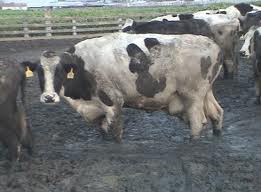
Resistance to antibiotics occurs when these drugs are used too often,  or  in inadequate doses. We try to encourage doctors to treat human patients with antibiotics only when they are reasonably sure they are treating a bacterial infection, and then to engage in overwhelming force, a sort of shock and awe attack. But 80% of all antibiotics sold in this country are not used for people--they go to cows and other livestock, in small doses, for two reasons:  1. Most cows are no longer allowed to wander grassy fields but are penned up in feed lots, standing in manure. They get infected and the antibiotics allow them to survive life in this literal cesspool.                   2. Somehow, livestock fed antibiotics seem to grow faster. 

Exactly how many cows get antibiotics is not known,  because antibiotic sales data is a closely guarded secret and all attempts at making it public by law have been thwarted by agribusiness and the pharmaceutical industry.  When Diane Feinstein and Kirsten Gillabrand tried to introduce legislation to report data the FDA already collects,  their efforts were rebuffed by a powerful agribusiness/pharmaceutical lobby.  

Henry Waxman (D-California) and Louise Slaughter (D-NY) have introduced a bill to require food producers to disclose how often they feed antibiotics to animals and this, too, is being fought by pharmaceutical companies and agribusiness.

Predictably, maybe not this year, maybe not next, but some year in the not too distant future, this will all come back to bite us. We'll have antibiotic resistant super bugs which will make Methicillin Resistant Staph, E. coli and resistant gonorrhea look like warm up acts. And this will happen because a few people were determined to protect their profits, public health be damned. 

Here we have the intersection of government, business and science and the first two are ignoring what the third has to say,  at the peril of everyone.

This has happened before, with global warming, with healthcare insurance, but in terms of what  will actually become most cataclysmic, the drug resistant bacteria will surely get humankind before the effects of global warming or the lack of health insurance do.


Tuesday, March 26, 2013

Chris Muns Hits the Ground Running


Just when you think government cannot do anything right, that democracy is a pipe dream, you hear about something which will change your life and the lives of your neighbors which some humble public servant has patiently orchestrated when he could have been spending time at the bar throwing back Smutty Nose drafts.

There is an abandoned rail road track which connects Depot Square in Hampton to Portsmouth. Grass grows up through the tracks and it's only passable during winter snows, when it is a decent cross country skiing trail and snowmobiles use it. Otherwise, it is unused, something of an eye sore and forgotten.

But Chris Muns has not forgotten. He's done yeoman's work talking to dozens of people in and out of government trying to convert this old railroad bed to an asphalt road you could ride your bike in from Hampton to Portsmouth without ever having a motorized vehicle cross your path or run you down from behind.  You could commute to work, safely and quickly,  by bicycle. 

He's had help from a committee of dedicated citizens, and he's hung in there.

The change this will bring to Hampton, if it happens, will be felt by anyone with children, anyone who rides a bike for exercise or pleasure. Where Rails to Trails projects have been invested in, like the Crescent Trail which weaves through and beyond Washington, DC, the trail becomes the town square.  You see all your neighbors and their kids out there every weekend. During morning commuting hours,  a few dozen hardy souls fly along to their jobs "downtown." On weekends,  roller blade
rs, bikers all commune happily. Nearby businesses find customers have wandered off the bike path to have lunch, buy drinks, discover restaurants. 


In Hampton, the breakfast and lunch diner at Depot Square will see more lunch trade. The hardware store, across the street will have to stock up on bicycle parts.  The pizza stores, all the way down to the new Flatbread Pizza will find more people, even during Spring and Fall.  The Old Salt may have to hire more waiters for the lunch crowd.  Gus's bicycle shop in North Hampton will see more customers.  Parents will drop off their eight year olds at Depot Square and know they are biking along a path where no cars can hit them. They can pick their kids up in Portsmouth, after a most excellent adventure as kids without hovering parents. They will have a safe haven, a long path to explore, to be kids out of a Normal Rockwell world. 

If the Hampton to Portsmouth link happens it will transform every town it runs past: North Hampton, Rye, Portsmouth will all benefit. Folks will wonder why nobody ever thought to do this before. That's what happened in Washington, D.C., where the common refrain has been, "How did we live without this? What did we do before? How did our kids grow up without this?"

In New Hampshire, they paint a yellow line on the road and call it a bicycle path. Bicyclists take their lives in their hands (and occasionally lose) biking along Route 1A, to breathe salt air. But a Rails to Trails is a safe, protected ribbon. From Hampton, you could ride your bike as a straight shot, have lunch at Popovers and fly back in under two hours. 

If and when this ever happens, whenever some Free Stater tells you government is not the solution, it's the problem, you can invite him down for a ride to Portsmouth along the trail a Democratic legislator got built.  He can try telling that to all the kids and their parents he sees along the way.


Monday, March 25, 2013

Ayn Rand Meets Medical Practice

Alexandre Yersin


Consider Dr. X, an acquaintance, I cannot say a friend, of mine. He is a very bright man, and hard working. A graduate of Princeton, he chose his specialty with calculation and he studied diligently for his board examinations and he did his fellowship in gastroenterology and he focused with great determination on learning the colonoscopy and endoscopy procedures. For several decades he aggressively sought patients on whom he could do his endoscopic procedures, which were, for years, paid inappropriately generously by both Medicare and insurance companies. 

But in recent years, Medicare has finally awakened to the fact that colonoscopies can be learned by almost anyone, with or without a medical degree, and can be safely performed in less than 40 minutes. The $2500 fee is going the way of the dodo and seeing the changes approaching, Dr. X decided it was time to bail out of direct patient care and he has shifted his practice in a new direction: He now makes $850 and hour testifying as an expert witness at malpractice trials.  

And he testifies not just about cases of alleged malpractice in the world of gastroenterology--the law does not require you be a specialist in the specialty relevant to the case before the jury. You can be a gastroenterologist and testify about a case of heart surgery, and base your testimony on "experience from years of practice."

So, for years Dr. X exploited a flaw in the medical system which allowed for very high payments for a mundane procedure; and now he is exploiting the medical/legal system and its irrationality and unsophistication,  as judges, who are lawyers, try to fathom the claims and counterclaims, accusations and defenses, concerning cases about which the judges and juries are hopelessly incompetent to judge. 

In the process, he has prospered, put his own children through Princeton, driven luxury cars, lived in large houses, vacationed in lovely lands. 

He has violated no laws, and he is a man for whom waiters reserve the best tables, about whom clergymen speak well for his contributions to the congregation.

And yet this man has raped the system, both medical and legal.

Ayn Rand would consider  him a hero. 

He testifies at trials of doctors who have done nothing more wrong than agreeing to care of patients in dire straights, who were likely to meet an unfortunate end, the classic "bad outcome" patients,  doctors who got sued for their efforts.  Dr. X is willing to show up in court for the plantiff,  to testify that these doctors were insufficiently attentive or simply made the wrong choices for their patients.  

Dr. X would say he has nothing personal against these doctors he testifies against; it's just business.

He has no trouble sleeping at night, because, he would tell you, it's not his fault if a hard working doctor who tried his best for a patient loses the malpractice case. It's just the way the system works.  Dr. X is simply taking advantage of the money which is being laid out there for the taking.

He has found his niche.

Then consider Alexandre Yersin, who was offered a plum position by none other than Louis Pasteur, at the Pasteur Institute, but Yersin chose instead to live in Indochina, now Vietnam, to treat the locals and to experiment with importing and cultivating rubber trees, providing a local industry for generations to come. And when black plague broke out in nearby Hong Kong, Yersin set off to find its microbiological cause, and he put himself at risk doing this, and he was successful and he raised anti serum to the plague and he became the first physician to successfully treat plague and to save patients from plague, all in the late 19th century, early 20th, before the age of antibiotics.

As we look to being hard headed about the "business of medicine," and as we hand over the design of our medical systems to men with MBA degrees, to accountants and managers, might we not consider the imperatives which govern the practice  of medicine and what makes medicine different from business, from selling insurance or automobiles or cell phones?

Ayn Rand would extol the virtues of the dispassionate Dr. X, and she might dismiss the value of Dr. Yersin as a man who never started a really lucrative business, who never exploited the commercial potential of cultivating rubber trees in Vietnam.

One might ask: which man would you like your son to grow up to be?

The Phantom never asks questions like that. The answer seems too obvious.
But, then again, in Ayn Rand terms, the Phantom is a loser.

Saturday, March 23, 2013

Look South, New Hampshire


Mad Dog's brother, the patriarch of the North Carolina branch of the family, emailed Mad Dog after Mark Sanford finished first in the Republican primary for the first South Carolina Congressional district.

"Who knew?"  he said, "House of Cards was a documentary?"
Well, Mad Dog knew.
What brother Dog was referring to was the story line of that wonderful Netflix series in which Francis Underwood, a Congressman from South Carolina goes back to his district to sort out a mess involving the death of a teen age girl who had driven her car off the road while texting about a local water tower, which was meant to be shaped like a peach, a tower beloved by the peach farmers in the district, but to the teenagers of the district it looked remarkably like a scrotum sitting atop a phallus, thus the text and the loss of concentration on the part of the girl. 

Francis Underwood had supported the construction of the tower, a source of some derision, so now he has to take responsibility for the girl's death.

Say what?

Now, a flinty citizen of New Hampshire might ask, how a Congressman could be considered liable for the death of a teen age girl who was dumb enough to drive off a road because she was texting, but the Congressman explains there is no point in blaming the victim. The parents and their friends want somebody to be angry at, and Congressman Underwood has been identified as the best target. There is a local politician who wants Underwood's seat, who is only too happy to stoke the flames.

Underwood goes to the church funeral service, and in one of the most brilliant scenes ever written for TV or film, he delivers a dazzling eulogy, which he begins with the words, "I hate God." The startled faces all around the church look as if they have been slapped.  He goes on to ask, "Haven't we all thought that when God takes from us someone as precious as Mary Elizabeth? We just get so angry and we cannot understand any plan, even if it is God's plan which would do this." Of course, he is talking about the resentment toward not just God, but toward himself. 

Underwood then goes to the parent's home and offers to resign from Congress, if they want him to. He looks to the camera in a sly aside and says,  "There is nothing more powerful down here than humility."

Now consider Mark Sanford, who was ousted from office for having an affair while he was governor, disappearing off to tryst with his Argentine paramour and lying about it, saying he was hiking the Appalachian Trail. Running for office he struck a posture of humility which was taken from the script and he, of course, won over the voters of South Carolina.  He had the stroke of genius to ask his betrayed wife, now former wife, to manage his campaign.  But he asked only after he assured himself she would not run for that open seat--she was considered a contender, but their two sons are still in high school and she did not think leaving them for a Washington job a good idea. Here's how the story ran in New York Magazine:

 Mark went to meet with Jenny at her house this past December to discuss the congressional race. As he later explained it to reporters, he wanted to be magnanimous. “I sat down with her on the porch,” he told one, “and said, ‘If you have any thoughts about running for this, then I’m out, because I can’t think of anything more disastrous than for a husband and wife to run against each other.” He explained that it was only after he’d ascertained that Jenny wasn’t going to run that he decided to proceed with his campaign.

Sound familiar?  My office is yours to deny.
And the voters of South Carolina, voting under their brand new restrictive voting laws, requiring photo ID's, went for it big time.

Now why can't New Hampshire be more like South Carolina?

Here in New Hampshire Jackie Cilley ran in the Democratic primary for governor and refused to sign a pledge saying she would never sign into law any income tax for the state of New Hampshire, if elected governor. Her opponent, Maggie Hassan signed the pledge,  Cilley said if you sign a pledge like that you deny yourself a bargaining chip with the legislature but at every event there was sure to be at least one old gomer who raised a hand after her presentation, no matter how long or short, and he would croak, "So, I hear you're for an income tax."  Cilley lost to Hassan. It wasn't even close.

Representative democracy.  Down South, it's all about humility and Evangelical fervor. Up here, it's taxes.