Saturday, August 15, 2020

Reading The New Yorker in New Hampshire

Many distinctions have been drawn between human beings and all other animals.
Human beings are the only animals who can use tools--nope. 
Human beings are the only animals who cooperate to attain a goal--nope:  chimps in a zoo in Belgium were filmed working as a team to lug a log, place it against the fence of their cage and then they scamper up and over the log and into the McDonald's next door.


But one thing which is close to mystical, that no other animal can do: Reading.
That little marks on a paper or screen can get into the minds of other human beings and a picture or a more ephemeral idea, math, engineering is one of the true wonders of the universe.

Mad Dog did not like reading in his pre reading days--reading was what seemed to put his parents into an opium den coma on weekends when Mad Dog, as a child wanted to be out exploring, running, playing ball. All his parents did was lie around or sit inertly  in chairs with books.

But once Mad Dog learned to read, he, too,  fell into that opium den coma--only after he had run himself around sufficiently to collapse into a chair-- and he, too, read. 
And then he drifted off with Huckleberry Finn, Great Expectations and Little Women. 

And now, still, reading turns out to be something transcendent. 

But not all reading is equally valuable. Reading Donald Trump's Tweets is not the same experience as reading Steinbeck or the New Yorker.

Reading The New Yorker in his Hobbit home in small town New Hamsphire opens a world for Mad Dog. Without leaving his chair, he can travel around the country and around the globe.

This week's New Yorker (August 17) has two articles which Mad Dog finds magical:
Peter Hessler's account from China, where he was teaching at a Chinese university when the COVID pandemic prompted their shutdown.  Then there is Dan Kaufman's "The Fall of Wisconsin" which seems in some ways even more  exotic and distant than the tale from China.

The best thing about the China tale is the trove of vignettes of the students Hessler provides.  From these, one can only appreciate the humanity of these people, who struggle to build their lives in a world which at once holds out promise, beauty, reward at the same time it clamps down on interaction between people, the free expression of discontent, individual yearning and hope.  

Hessler teaches a class which might be described as journalism and he limits the enrollment, but one young woman manages to convince him to allow her in, which he finally agrees to do, and he discovers she is one of his best students who manages to get stories nobody else can gain access to, because she is so ostensibly harmless and unassertive. But Hessler forgets to fill out her forms, so she cannot get credit for the course. She shrugs this off and says she will finish the course and then take the course again the next semester for credit and Hessler remarks how very Chinese this is: she never recriminates him, but continues react to him as a respected and valuable superior, even when he has acted "like a moron."

Kaufman, on the other hand, tells a story which geographically is closer to home, in rural Wisconsin. In some ways, it is easier for a college educated person like Mad Dog, to relate to the students in China, who struggle to work their way through the requirements, to please professors and do assignments, on faith this will somehow, some day, help them find a place in the world and to advance.
Because Mad Dog spent so many years in school, it is easy to understand the students' mind set than it is to grasp the world view of the farmers in Wisconsin, who get up at 3 AM every morning to milk cows, who milk cows three times daily, whose fathers find the fates of their farms and families are controlled by forces in Washington, DC, where the size of herds, the price of milk, of soybeans and corn are determined.  

The bleakness of lives when deep debt turns bad leads to understandable desperation and ultimately, for some, to suicide, as economic ruin turns to personal recrimination. You cannot run a farm with the expensive equipment, expensive animals and infrastructure without acquiring debt and when a man like Earl Butz comes out to Wisconsin and tells farmers, "Get big or get out," i.e., go into debt, get big herds and expensive machinery to milk those cows or sell your farm, you can understand the resentment. 
Then you have federal government big shots telling farmers to plant fence post to fence post so America can sell soybeans and wheat to China and Europe, only to have those markets collapse in a trade war.
One would think you'd have a revolt.
But, strangely enough, some farmers shrug this off, and one says of Trump, "I don't agree with everything he says but he's the only President who has ever tackled the trade issue." 

Another tells of being invited to a Trump rally, "I was sitting in the second row behind the President. It was unreal. I felt more inspired than I ever have in my life. I'm not a big patriotic, flag waving person, but I felt very patriotic going to that. My son, too. He's twenty, and he kept saying, 'Oh, my God, Dad. Oh, my God.'"

Kaufman describes how voting in several key counties in Wisconsin swing the state and you realize, if you are sitting in New Hampshire, that things happening far away may swing the election no matter what you do.  
It is essential for rod to have a reel and line and a steady hand on those parts, to provide a base, but little movements in the tip of the rod, in the line as it flies out across the water make the difference about whether or not that fish gets caught, in the end.


Saturday, August 8, 2020

New Hampshire Death Spiral


Demographics sounds like a major yawner.
The study of statistical profiles of populations.
But a demographer, Peter Francese has written (along with co author Lorraine Merrill) a short book about New Hampshire demographics which has, for Mad Dog, been nothing short of revelatory. "Communities & Consequences II" which has also been produced as a documentary.


Obadiah Youngblood Lesser Boar's Head 


It has tied together a set of observations which puzzled Mad Dog for the over 12 years he has lived in the state, but never seemed a coherent whole, until now.

1/ Mad Dog, questioning neighbors about why they kept voting against the warrant articles to refurbish the middle school (Hampton academy), was told that the renovations would be too expensive and would raise property taxes.

2/ When Mad Dog replied that good schools are the one thing a community can do for the future of everyone, he was told that was a lovely sentiment, but dollars and cents mattered more. When Mad Dog said good schools were what raised property values in the in the Maryland county where he once lived,  that people paid premiums for houses in good school districts, he was told New Hampshire is different,

3/ In the small town of Hampton, Mad Dog has been struck by new developments of homes occupied by retirees, over 55 communities, where children may visit but not live.

4/ Mad Dog marveled at the amateur New Hampshire legislature, in which representatives serve virtually unpaid, making it impossible for anyone but retired folks or housewives or the independently wealthy  to serve. "It's the closest thing to real democracy" his neighbors said. "We don't want people to serve for the money, but because they want good government." So young people who need to make a living need not apply. 

5/ The third rail of New Hampshire politics is the phrase "income tax." Any candidate to fails to "take the pledge" to never sign into law a state income tax is in fact signing his or her own political death warrant.


What Francese & Merrill document is that since 1990 New Hampshire has sought to become senescent,  relentlessly and intentionally, and has succeeded remarkably and is now the 2nd oldest state in the union, behind Maine.
Persona non grata 

It has done this by means of laws passed by its state legislature and by local governments, zoning boards, town councils which have discouraged young families with children from moving to the state by virtually banning "affordable housing" or apartments which might be attractive to young people. By simple rules requiring houses to be built on 2 acre lots, housing density, affordable housing has been discouraged.  The state encourages older, wealthier people to buy second homes in New Hampshire which remain unoccupied most of the year, further reducing available housing and driving up real estate prices. 

Workforce housing, which is located near places of employment, which is year round is increasingly rare in the state.

Affordable housing in New Hampshire towns often comes down to areas occupied by mobile homes, which tend not to house children but more often retired adults.
Obadiah Youngblood  Studebaker Mansion

So this is a "perfect storm" of an aged legislature, which regards children as an expensive burden, which should not be their problem but someone else's problem. 
Children require schools and schools, funded only by property taxes, raise taxes.  In some towns older people are forgiven some portion of their property taxes, but they are not considered to be burdensome as they reduce the tax base; it's the children who are considered a burden. And since the state abjures sales tax and income tax the only way to support schools is through property taxes. 

Other people's children are simply viewed as other people's problems. There is no sense of community among people who see the next generation as the other.

Of course, this is not seen as selfishness by the aging parts of the New Hampshire population; it is seen as self preservation.  "I worked hard for my Social Security and Medicare" and now I don't want to give up dollars to help those coming behind me; they can work for themselves.

As Fracese shows, this is actually a misconception: The fact is, more young families do not add many students to the local schools, where enrollment has been on the decline for 30 years, since efforts to discourage young families have been in full swing. It will take years to repopulate schools in districts which have been relentlessly denuded of children for the past 30 years. 
Obadiah Youngblood  North Hampton Salt Marshes 

It's been a effort at ossification.  The new--new families, possibly immigrant families, possibly poor families--are seen as a threat. It is as if the whole state has decided to become a retirement community. 

And as the death rates climb and the birth rates fall, graduates of  New Hampshire colleges and high schools leave forever, seeking happier hunting grounds, where they are wanted.

And they take with them the skills and energy to revitalize and grow those towns in Massachusetts, New York, Pennsylvania and Maryland which welcome them.
Expensive burdens 

It sounds like that P.D. James novel, "Children of Men" where the birth rate has fallen to virtually zero, where infertility reigns and babies are never seen. 
But rather than seeing this as a demographic and economic disaster, a dystopia, the current insular population of New Hampshire welcomes this as a sort of Shangri la. 


Tuesday, August 4, 2020

Axe Murderers of Hampton, New Hampshire

Along Route 27 from the interstate exit to where the road ends in the beach, men in trucks, sometimes protected by town police, have been felling trees, mostly 100 foot pine trees, likely almost a century old, and have left the road denuded, like those clear cut areas on the Olympic Peninsula in Washington state. 

Vandalism on High Street


The loggers have progressed to what Mad Dog had thought would be sacred ground, the graveyard across from Hampton Academy, where a stately line of pines had formed a border, which is now nearly completely leveled.
Haven't fallen in 100 years; now a threat

The reason for this lethal attack on old trees can only be inferred. Mad Dog has not seen notice about this. He has inquired through the town website, but none of the folks who live along the road where this destruction has been wrought seem to know, and everyone's best guess is the trees are being chopped down to prevent them from falling on the power lines which run along the road.

If so, this is a clear case of deforestation for the purpose of protecting moneyed interests.
Welcome to Hampton

You don't hear people talking about Hampton as a pretty New England town.  It's got a work-a-day look. The old railroad depot houses the best auto garage in the area, but other than the gazebo, there has never been much effort made to make the area appealing to the eye. 
Beautiful downtown Hampton
Beach landscape is often barren, but Hampton has some pretty salt marshes, which have been largely surrounded by buildings, beach houses mostly. The Academy middle school is, finally, a lovely structure and the high school, hidden from Winnacunnet Road, is nice enough.  Ironically, the name "Winnacunnet" is said to mean, "Place of beautiful pines." 

No longer.
Save the power company


No citizen of Hampton should criticize the deforestation of Brazilian rain forests, given what we have silently tolerated right here in Hampton, New Hampshire, USA.
Ok, I've seen the dump but where's the town?


Saturday, August 1, 2020

The Coming Civil War

Reading Malcom Gladwell's "Talking to Strangers" and his description of the two British leaders who actually ever spoke to Hitler before the world war, the description was so shot through with deja vu I could only stand up and stretch to be sure I was still in the present. 

Both men misread Hitler so thoroughly because they made a basic assumption, borne of their British class system: Any man who rises to leadership must be special, a man who had, figuratively speaking, drawn the sword out of the stone. 

But Hitler was not a special man. He was not crazy, but he was simply willful and not particularly bright. He was exactly what he appeared to be and neither Brit could see that. They had always dealt with people who said one thing in public, another with friends and another in the company of people who were not in their own club. But Hitler simply said what he meant. Neither, to my knowledge, had ever read "Mein Kampf," --or, if either had, clearly neither learned anything from it.

Hitler was just a "vulgar little man" not the sort who could be consequential in the eyes of the British aristocracy.

Mr. Trump, similarly, has been dismissed, misread as simply a rabble rouser who could not be taken seriously, even when he says he will not accept the results of any election which ejects him from the White House. 

And any election which results in rejection, will be, by definition, a fraud, and unacceptable.

It will have been stolen by mail in ballot fraud, by fraudulent voters crossing state lines--as he said they did in 2016 to give New Hampshire to Hillary.

So, he will insist the election, if he loses, is null and void.

People have already done game theory about this.

The case will go to the Supreme Court, which will have only 8 justices by November, and Alito, Thomas, Kavanaugh and Gorsuch will vote for Trump. Breyer, Kagan, Sotomayer and Roberts for Biden, so there will be no decision.

If Roberts goes for Trump, in the interest of avoiding a Constitutional crisis, the Democratic House and newly shifted Democratic Senate will refuse to accept the Court's verdict.

Then the street fight will begin, first in the old Confederacy and Mountain West, but most viciously in places like New Hampshire, Pennsylvania and Colorado. 

Attorney General Barr will order in Homeland Security and every federal agent from the FBI to the US Marshals, all decked out in camo, but this time they will need  to look like actual soldiers, because the Joint Chiefs of Staff will order in their troops and then you will have the spectacle of the 101 st airborne shooting at Homeland Security.

Who do you think wins that fight?

Then you have state national guards under the command of governors,  and Mr. Trump will order them federalized them, but each case will be resolved differently. In the South the national guard will support Trump, but not in Blue states. 

The most peaceful parts of the country will be the Red State heart of the Confederacy and Mountain West. 

The coasts will erupt in bloodshed, but the Army will contain it mainly by refusing to obey Trump.

The real bleeding will flow from Kansas north to Wisconsin, right up the middle of the country. 

In the end, we'll have a bicoastal nation, with some Midwestern member states (Minnesota, Illinois and maybe Michigan.)

And that may not be such a bad thing.  

The Northeast and West Coast will prosper economically. The South and those defiant Red States will struggle, but they'll establish enough trading links to be viable.

And the continent will be, like Europe, divided, but in some ways happier.

Rich people from Michigan will still be able to fly south to Florida for the winter and commerce and banking between the new nation states will continue.  Travel between states may require passports and there may be tax barriers set up. But Amazon and Face Book will still bind the states together, so, in the end it won't matter much to the citizen of New Hampshire he cannot just hop on a plane to South Carolina, because he never really had much to do with South Carolina, apart from one excursion to Hilton Head.

Those big military bases, the military contracts to industry will, of course end in the South and that will cause some financial pain. The South will be poorer for the poor and middle class, but most of the upper 1% will still thrive, as it always has in the old Confederacy. 

And for the coastal states, life will actually be more pleasant, unburdened by having to send far more dollars to the South to support Social Security and Medicare and education and FEMA, those states will be wealthier and less burdened. 

Lincoln looked at the wars among European states and held fast to the idea that this continent should be held together by one nation.  But times have changed. And we won't have kings in the various states. 

So, in the long run, we'll likely be better off.

As the fat man told Michael Corleone, sometimes you have to go to the mattresses and just have a war, to let the bad blood out.


Saturday, July 25, 2020

Trump's War Against the Cities


That snappy line, "Pennsylvania is Pittsburgh and Philadelphia-- and Alabama in between," of course now  applies to every state in the union.

Even as reptilian a brain as resides in the skull of Donald J. Trump can appreciate that if Civil War were to break out in the United States of the 21st century, the dividing sides would not be along the old Mason-Dixon line but between the cities, suburbs on the one hand and the rural areas on the other. 
Ft. Sumter, South Carolina

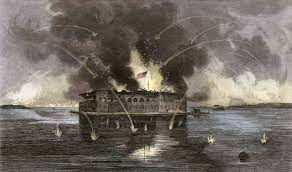
So Trump has engineered a sort of reverse Fort Sumter, by sending troops to various "federal properties" like federal court houses in "Democrat run cities," those dens of iniquity, and having the federal troops move out to attack the citizens of the cities which surround them. It's as if the feds moved out from the fort to attack the city.
Not Fallujah: Portland, USA

Fort Sumter, sitting in the Charleston harbor, was a cinder in the eye of the nascent Confederacy, which had in December of 1860 declared secession and in April got around to bombarding the federal fort in the harbor. 
Now, it's the feds who are bombarding the city around it.
Bringing Order: The White Supremacist Way

Of course, Mr. Trump must see now more than ever, his strategy of creating tumult is the only viable path to winning re election. Without perturbation, the murderous, inarticulate, seething core of his support would wither. Trump fans live for the violence. 

One might say the citizens of Portland and Seattle have taken the bait.

Richard Nixon used the burning cities of America to cruise to re election, appealing to those who saw the urban disorder as something which had to be ruthlessly suppressed--Nixon's silent majority had to feel personally threatened by the colored people who would burn down America, as he tacitly implied they would.

Trump is playing that same card.
Auxiliary Federal Police

Just this morning Mad Dog listened to a podcast, "The Daily" from the NY Times, in which one callow reporter interviewed another and they were both puzzled, struggling to understand what these camouflaged clad federal "police" from the Border patrol and Homeland Security were doing in downtown Portland.


Portland, Oregon, United States of America

They were not old enough to remember the 60's nor had they read enough history to have any hope of diagnosing the tactic.


Monday, July 20, 2020

Michael Mina: What if Covid Could be Arrested in 30 days?

Are you ready for a conspiracy theory?

What if there were an invention which could stop COVID 19 in its tracks in a month or two?

What would be the effect on our nation and the world?

Would this insure Donald Trump's re election, as the virus, "like a miracle" ceases to paralyze the nation, just as he promised, by, say, late October?

Listening to TWiV 640, Mad Dog was stunned. Here are the links, if you're interested, but you're not, because it takes an hour and you're too busy to take an hour right now. So the short and dirty summary follows.

https://www.microbe.tv/twiv/twiv-640/


Here, after all, was a trusted group of TWiV nerds who interview a Harvard infectious disease specialist at the School of Public Health who calmly, methodically lays out a solution to most of the problems of COVID 19 with a simple solution, relatively low cost, which clearly will work--a plan you do not need 4 years of medical school to understand.

It begins with Michael Mina, MD, PhD at the Harvard School of Public Health and his interview with the TWiV nerds. 
Dr. Michael Mina

It's very simple, but it requires a few leaps of faith:

1.1st LEAP:  There is a simple test for the RNA of SARS COV-2 which is a home test, like home pregnancy kits, which requires just a glob of saliva and a few minutes later you know whether or not you have the virus in sufficient quantity to be infectious to other people.

                      The test is imprinted on cardboard strips and can be manufactured in the millions at low cost at a variety of centers--universities, drug companies, all over the country and if logistical problems an be solved, every school child, every school, every university, every employee, waiter, air line,  could have these strips in hand and use them every day because they would cost only about $1 per strip.

2. 2nd LEAP: The government and business could organize and cooperate to the extent where these strips could be put into the hands of nearly every American.

3. 3rd LEAP: The profit motive could be abrogated to the extent that the government pays for the strips and nobody profits from them, apart for the general economy which could then safely send kids back to school, workers back to factories, airplane passengers back on airplanes, in short we could re open the economy, without masks and without fear of a new outbreak.


What could possibly go wrong with this rescue scenario?

1. Rigid government regulators at the FDA:  Such a system would have to be endorsed by the FDA, which would have to say these strips are reliable enough to trust and clinically useful. 
2. Companies (and Trump family members) who see a chance to profit handsomely from manufacturing these simple strips.

And here's the rub: The FDA has rules and current rules are meant to guide not public health, but clinical care of individual patients on wards and in doctor's offices. For these clinical settings you may want a test which does not miss viral disease particles--you want a "highly sensitive" test. 


But for the purposes of public health you do not need a highly sensitive test.
You can afford to miss people who have the virus--but not enough virus to transmit to others. Patients with low levels of virus are not a threat to the rest of us, to the public.
So if a patient has the virus at  low levels the saliva/stick test will miss it:  BUT THAT DOESN'T MATTER! That kid can still go to school because he won't infect anyone.
But the next day, when his virus load stokes up the saliva/stick test catches that and turns positive, he stays home. 

So sensitivity for the purposes of public health is irrelevant. All we care about is transmission to the group, not the individual, not whether the individual is early or late in his disease. You need one sort of test to treat an individual patient but another sort for defense of public health.

Imagine if all the school kids, employees, airline workers and passengers could wake up every day, test their saliva and those who are infectious stay home.


Wouldn't that be wonderful? Wouldn't that stop the pandemic in its tracks?
Well, maybe not dead in its tracks. We have people who won't wear masks--what makes you think they'd do the tests at home and if + would not go to work anyway?
But you could do them on kids at school, at airplane gates, at factories. You use thermometers, which granted takes only 2 seconds, but you could stagger arrivals and do tests which take 5 minutes. 

Now consider this: We have this test. It's sitting on a desk at the Harvard School of Public Health, and other places, but nothing is happening to get it mobilized. 

We have the saliva test bomb but we do not have the leadership to organize its deployment.

Now, let's think politically, just for fun. 
Suppose Trump administration officials are smart enough to learn about this and implement it by late August and by late October disease rates are vanishing. 
Who do you think wins  the election?

Or, suppose, Joe Biden comes on every network, every social media outlet and says, "I have a way to end this pandemic" the way Nixon had a secret plan to end the war in Vietnam?  Only, in this case, the plan is not secret. Joe gives it out and says Trump has been so inept he did not enact this simple solution.
Joe hammers Trump with this every day.
Videos explain it all with cartoons so everyone can get it. 
Who wins the election then?

But, as the virologists on TWiV lament: Nobody who counts is listening. They are all too busy on Facebook, Twitter and CNN.


Too bad, it could have worked. 

Friday, July 17, 2020

Tony Fauci on TWIV: Lighting a Candle in the Cursed Darkness

Today, TWiV interviewed Dr. Anthony Fauci and Rich Condit and Vince Raccaniello asked all the right questions, to which Dr. Fauci responded as best he could.

https://www.microbe.tv/twiv/twiv-641/

Above is the link, which is well worth the 30 minutes, but for those with tight schedules, here are some highlights:


These are old friends to Dr. Fauci, and he clearly was happier talking to these folks than to most reporters, because among these colleagues he didn't have to shape his answers to his audience, but could simply talk freely with people who would understand the subtexts.


One of his off the cuff remarks was revealing, in answering a question he said, "That's one of those questions where you have to say you don't know, but they ask but what's your best guess? So you give your best guess and then they come back to you months later and say, 'You were so wrong!'"

We know what he's talking about here.

At 79, he clearly has not lost a step: In answering a 5 part question he said, "Usually with these multipart questions I cannot remember the questions after the first one, but with this one all 5 questions are related, so I can take a shot." And he worked methodically, flawlessly through each one. So there was that capacity to sound humble and then demonstrate sharpness. 
This is not "humble bragging," where someone complains about his sore hand from shaking the hands of the throngs who adore him. This is simply Fauci being confident that even if he cannot recall all the parts, he still has something to offer.
It's just the sort of intellectual confidence Trump and all his FOX News acolytes lack. They ramble and digress; he focuses. 


His TWiV interlocutors focused on basic themes, which the TWiV folks have dissected and elaborated upon previously, to get Fauci's take.

1/ What is the behavior of this disease?
Is it a virus which mostly sticks to mucosal surfaces (lining of the mouth, nose, throat and lungs) or is it significantly viremic (blood borne)?
This is important because a respiratory coronavirus  which sticks mostly to the mucosal surface typically provokes an immune response which is ordinarily transient, lasts only weeks or a few months. 
If SARS COV-2 is like its cousin coronaviruses, then any vaccine we make to it may be only able to protect for a few months, or even less.

Dr. Fauci said only autopsy studies will be able to answer this question and there are not enough data yet. "A data free zone" as he put it. 
What he did not say is autopsies are no longer routine in America--pathologists don't want to do them, especially when they may get infected in the process and typically only university hospitals do them, and not many at that. 

When a virus is blood borne like measles or small pox, then the immune system activates B cells and T cells and immunity can last for years. But, so far, this virus does not look like it has much blood borne time. And case reports suggest patients who were sick with COVID19 in March are getting sick again with + PCR in June. Recrudescence or re infection? Nobody knows. 

Questions about death rates, prevalence could not be answered with good data, but as Fauci pointed out (and as TWiV has elucidate previously) if the virus is really lethal, it tends to burn itself out (like MERS) because it cannot leap from a dead person who is not out there in the community the way it can if it has asymptomatic or pre symptomatic people spreading it as they go out among the community. When a virus is killing only 1% of its hosts, it can spread more widely--it can infect nearly the entire population, over time.  But if only 1% of 300 million people die, that is still 3 million people. 

2/ Vaccines:
Much discussion was given over to a discussion of vaccines and Raccaniello pressed Fauci on the topic Brianne Barker and others had examined: Are we putting all our eggs into one basket with vaccines aimed only at the spike protein (which attaches the virus to the ACE receptor on cells as it opens the door, yanking on that door knob)?   
Barker and others noted that vaccines which elicit immunity to other parts of the viral genome may be necessary to elicit robust protection. There are many steps in the invasion of the cell, in the process by which the virus takes over the wheels of the cell, but  going after only the spike protein is like having all the defenders on the front line, with nothing behind them if the wall is breached. 
And, as Barker noted, it's not even clear that B cell antibodies are what really confers protection--T cells may be more important and we have very few studies showing how well vaccines work on T cells.
Antibody levels may not tell you much about levels of protection: Antibody levels can rapidly stoke up with the second exposure, so low levels may not mean much. On the other hand, if antibodies are not protective, they may not tell you much.

Fauci, typically, responded that going after spike proteins has worked for other viruses and the idea is to go for what has worked for other viruses in the past. He wants to see "neutralizing antibodies."
When pressed, he did say other targets on the virus have been identified by some of the other companies working on vaccines.

3/ Masks: 
Do masks work and are we making a mistake opening schools even with them?
Fauci mentioned the NIH has a 6000 person, 2000 family study about how children get and transmit viruses to their families and others and once this is done, we'll know more about what we need to do about schools. He did say schools have got to open but the way this is done will have to vary by locale. In some counties, no masks no precautions may be necessary but in other places, all precautions will have to be tried. [Subsequent episodes of TWiV mention the report of 3 hairdressers, all SARS CO-2 positive but wearing masks worked on 139 customers and none of the customers turned positive, suggesting masks are effective in blocking transmission.]

4/ Asymptomatic illness and transmission: 
Fauci refers to the incident on the aircraft carrier Theodore Roosevelt where only 20 sailors were ill but 1000 sailors tested positive and said, "Hard to imagine those 20 sailors directly coughed on all 1000 other sailors."


Fauci has been attacked, predictably, because he is the messenger but there's more to it than this.  As Trump noted, early on, he's become a rock star and he eclipsed President Trump on the stage, stole his spotlight and Trump could not abide that.


Fauci is everything Trump is not:  Fauci is short, humble and understated. 
But he has the quality Trump strives for: the common touch. 
His language is scaled down to conversational.
He does not strut or try to impress.
He doesn't have to try to impress. His reputation, his back story precedes him.
He went to an Ivy League medical school, from there to the NIH where he became the youngest man to head an Institute and where he organized the campaign to bring AIDS under control, which turned out to be one of the most successful public health efforts "ever." Of course, he did not do this alone--he was an organizer, not a bench researcher and he did not make scientific breakthroughs. He was an Eisenhower, organizing talented generals to galvanize a victory.


He can afford to be humble, because respect precedes him into the room, and it must have, mortified Trump to see the members of the press listen with rolling eyes as he spewed out his daily fantasies and delusions about the virus melting away like magic, only to see these same people sit up and urgently raise their hands when Dr. Fauci took his turn at the podium. 
Trump saw what so many kings and politicians have seen before him: Political power is a construct, a social game we play, but when people are really worried and looking for leadership, it's the physicians they worship.


Click on this to get the real effect

But when the physician plays the role of the parent and tells people they cannot go out and play and do the pleasurable things they adore, they react as children do--with petulance. Or they take the warnings as insults to their own parenting and they accuse the government officials of acting like parents who smother their children and do not allow their children to risk and to learn.


Fauci is "the real deal" while Trump, even to his fans, must be the entertainer, the fantasy spinner.

Not to say we do not need fantasy spinners. 
Humankind cannot bear too much reality. (Eliot)